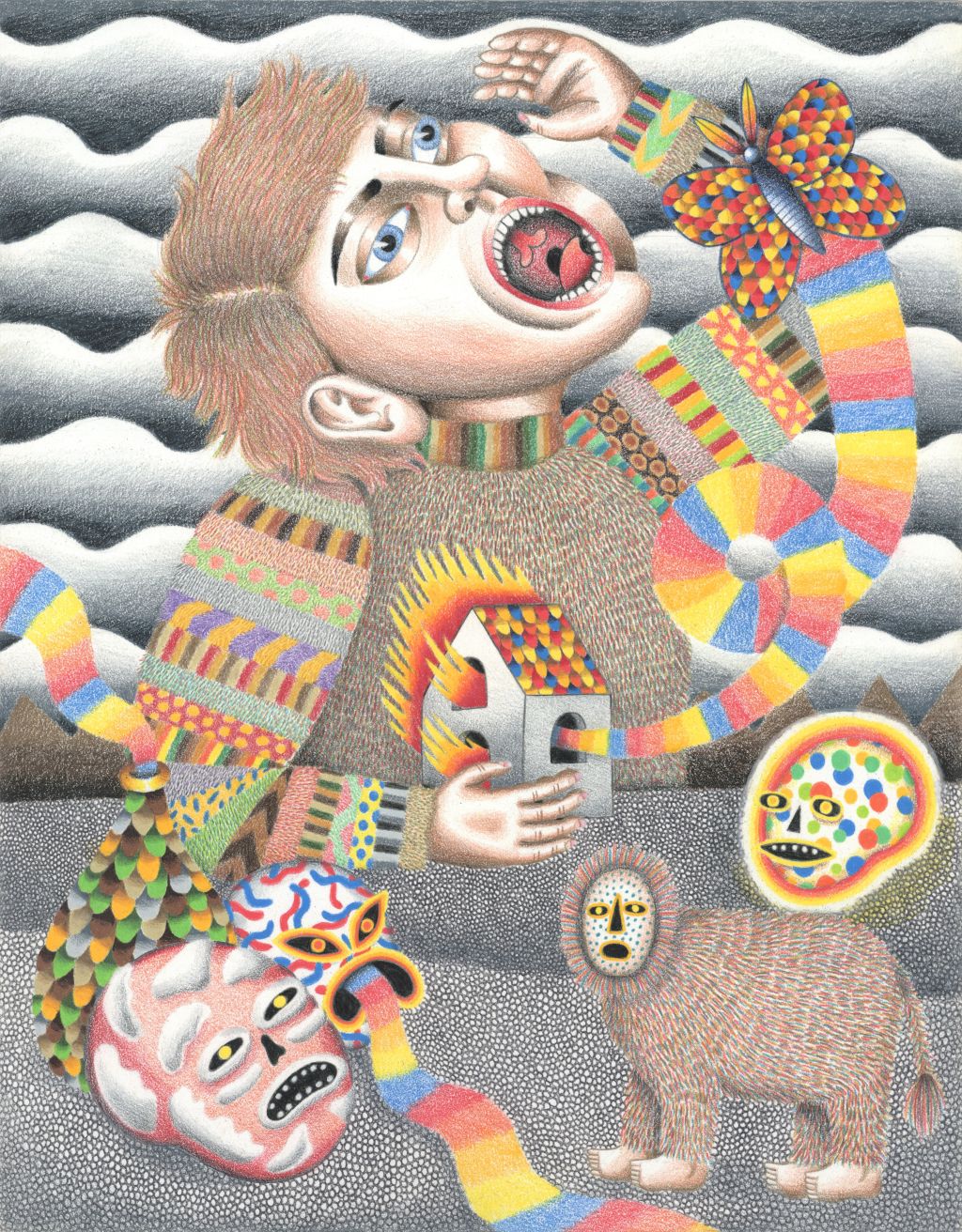
first published in All The Little Things That Happened In Our Heads by John Vochatzer (San Francisco: Moth Belly Gallery, 2024).
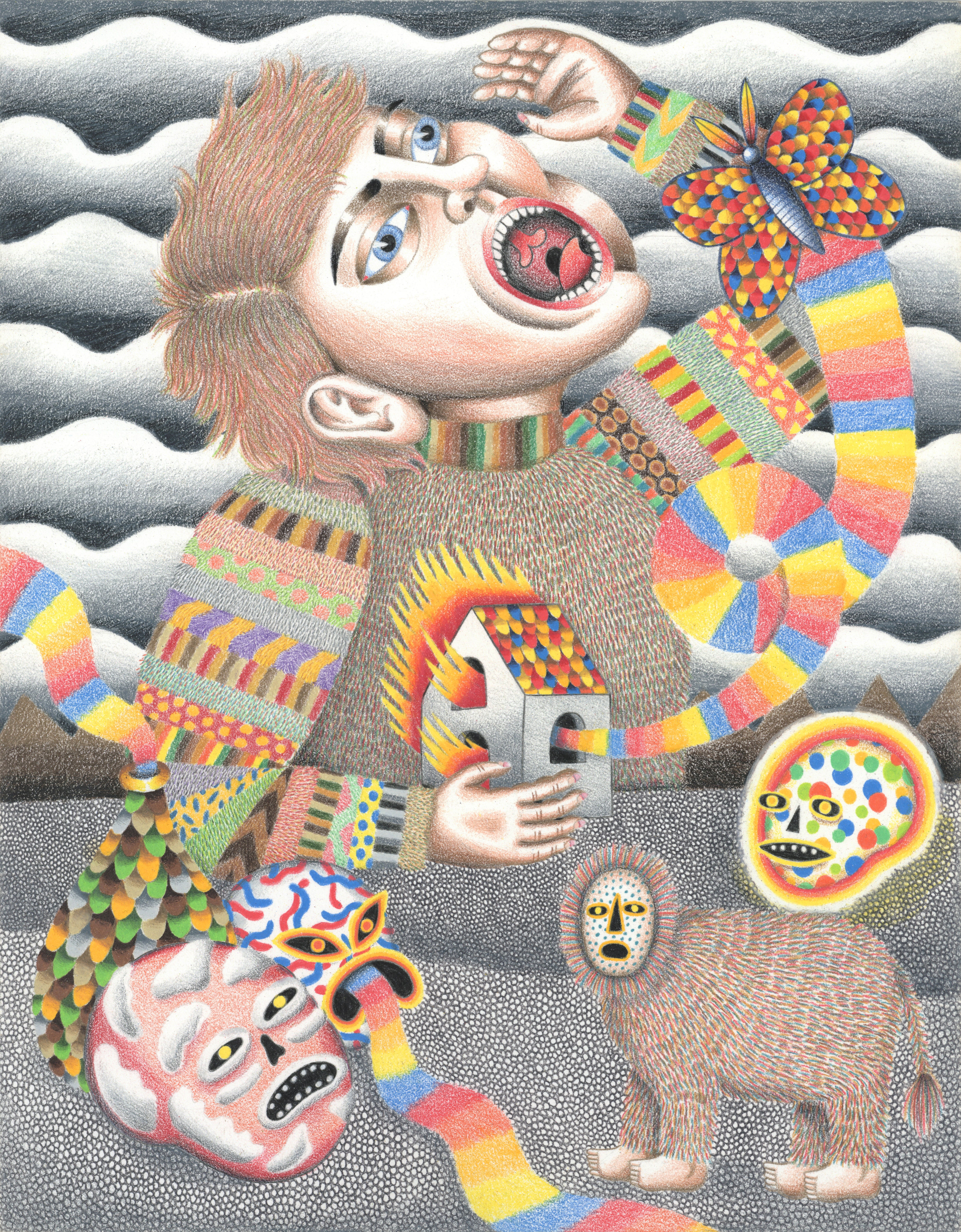
“All The Little Things That Happened In Our Heads” by John Vochatzer (San Francisco: Moth Belly Gallery, 2024)
Foreword by Matt Gonzalez
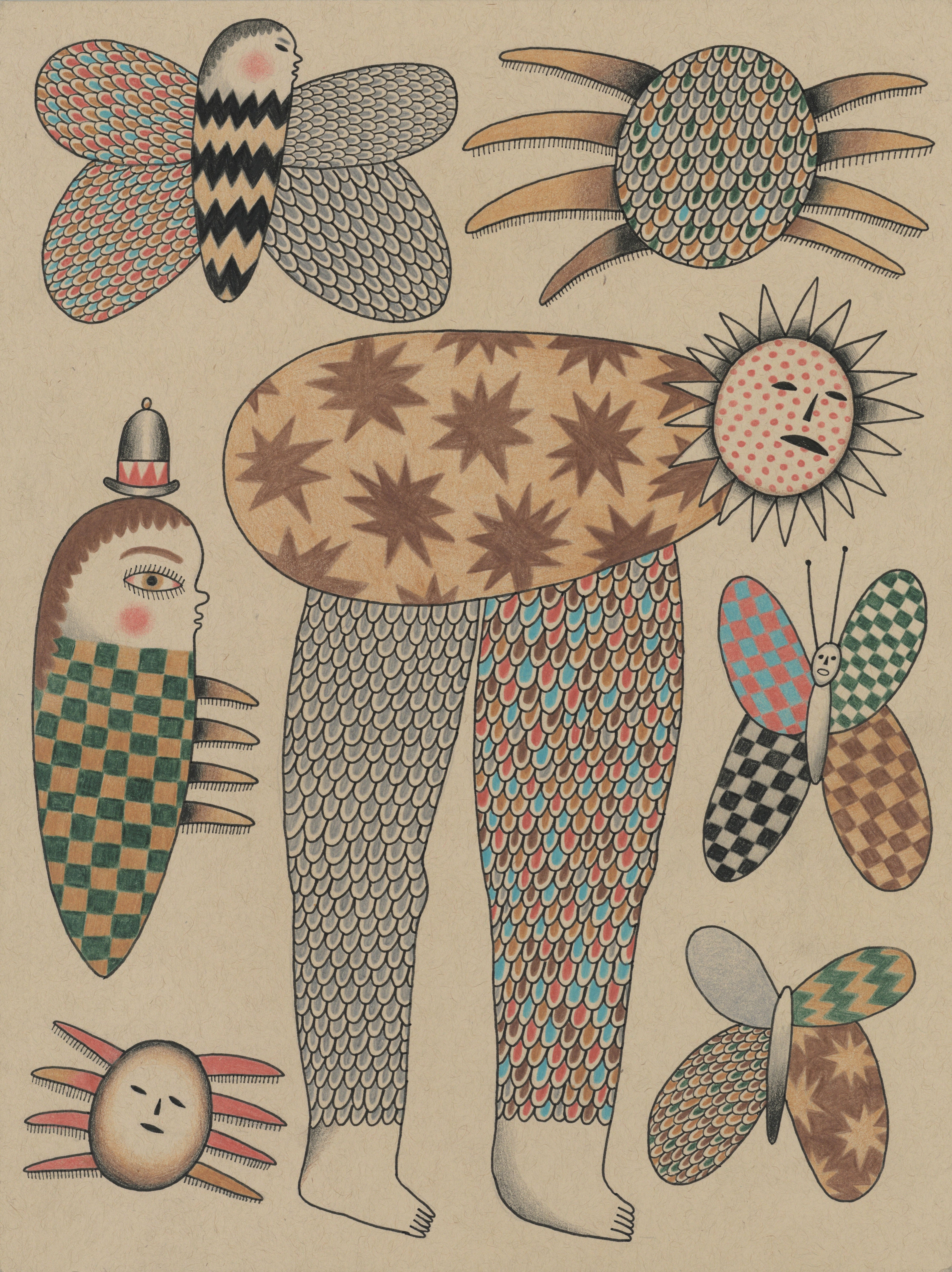
In his exhibition “All The Little Things That Happened In Our Heads,” multidisciplinary artist John Vochatzer exhibits one hundred drawings from a larger series of works he began in 2021. Consciously wanting to break away from what had become his signature style – a detailed and layered, resin-covered, collage practice – this new body of work draws on his experience as an illustrator and offers an opportunity for Vochatzer to explore a simpler art-making process that highlights essential flat line design elements. In doing so, he manages to retain the complexity of his artworks while relying on an inventiveness which conveys a personal landscape and vocabulary of absorbing imagery.
Rather than continue making what is secure and calculable, Vochatzer withdrew from the anatomically surreal and grotesque collage works he is known for, and which were featured in the quarterly art magazine Hi-Fructose in 2019. Eschewing the more-is-more doctrine of his maximalist aesthetic, in this new work Vochatzer boldly has simplified his art making practice by relying on unadorned tools: oil-based colored pencils and micron pens. Left behind is the tornado of paper his method once necessitated. This new body of work represents an important evolution in Vochatzer’s work. Notably, it coincides with Vochatzer being sober for the first time in his life and launching Mothbelly Gallery in the Tenderloin with fellow-artist KT Seibert in 2020.

These new works, which are primarily made on toned drawing paper or bristol board, also show the influence of his apprenticeship and subsequent work as a tattooer; they are in effect an extension of the designs and tattoo flash he composed. In Vochatzer’s case, this tenure enabled him to start emphasizing the essential parts of imagery; how infusing recognition can come from austerity. This is the first time Vochatzer has exhibited these drawings in a large grouping. A few have been shown in group exhibitions or fundraising auctions; but this is their inaugural presentation as a cohesive collection. The exhibition comes at a time he is exploring, yet again, embarking on new mediums, thus making this exhibition a culmination and divulgence of sorts.
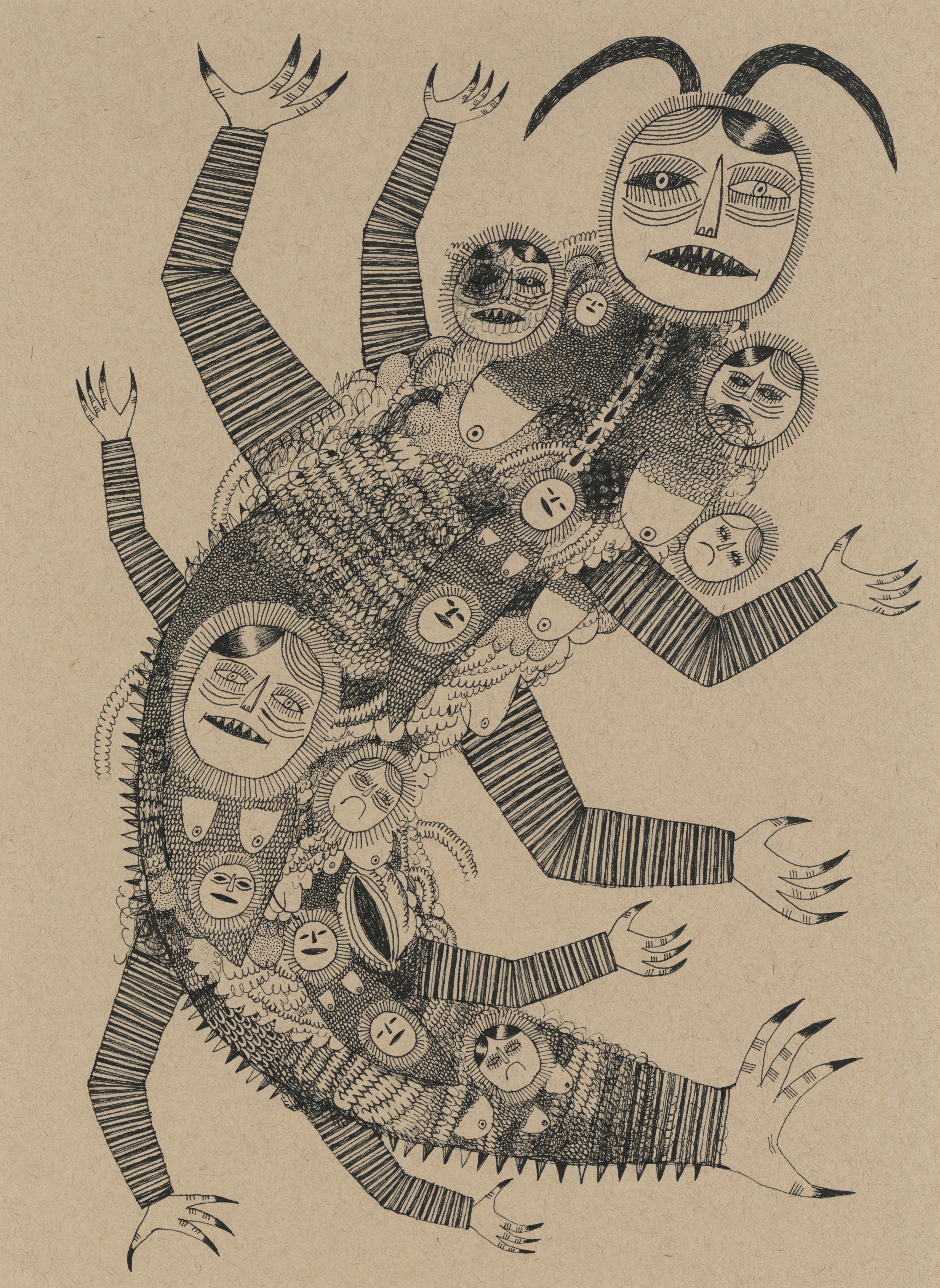
The drawings themselves are populated by an array of animals and anthropomorphic creatures. Moths, butterflies, fish, spiders, crabs, lizards, birds, caterpillars, and scorpions, all materialize alongside invented, wild, and unknown creatures. These all comprise Vochatzer’s engaging menagerie. Recurring themes abound, for instance, figures and creatures are depicted being birthed or escaping the body of another, in effect, fleeing an enclosure. Figures are often covered in tattoo elements: flowers, skull & crossbones, open-mouthed leopards, daggers, sun & moon motifs, are littered throughout the drawings. Many of the compositions have what appear to be aboriginal design patterns; simple elements that populate backdrops and embellish landscape elements. Human figures or stand-alone faces, are rendered with simple countenances; either with smiley faces or sometimes grimacing. Vochatzer is purposefully rejecting traditional portraiture while still conveying the effect of personhood and immediately recognized emotion.
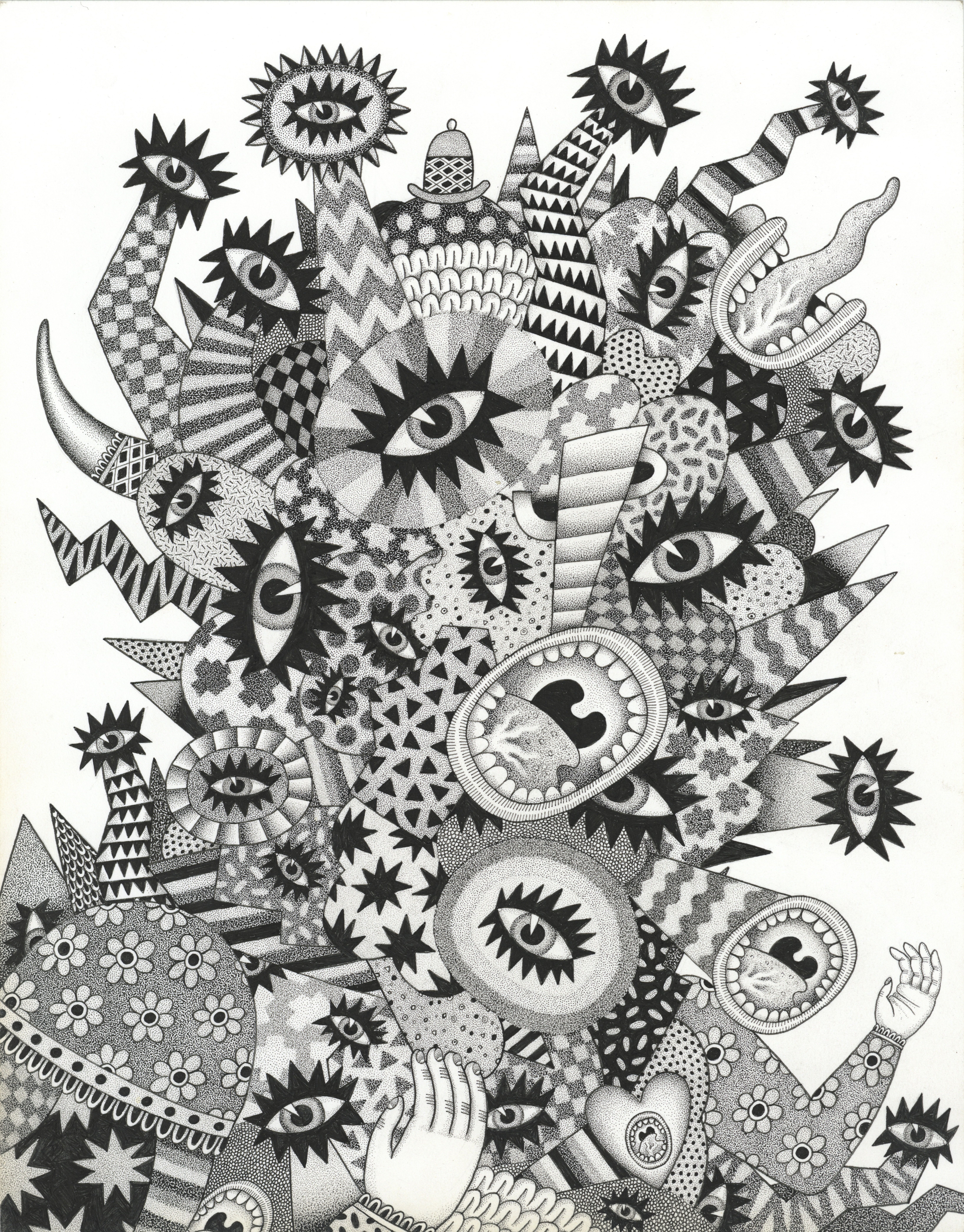
Reflecting on the past three years, Vochatzer’s work encompases a large gamut of thoughts and emotions. In addition to the changes he’s seen in his own art work, he acknowledges how the cathartic transformation into sobriety has also made him a more stoic person. That transformation is the spark or impetus for these drawings. Vochatzer’s imagery often conjures up metaphors referencing the holding of elaborate sensations, not the least of which is living in an increasingly complex world. In “Self-portrait’ he presents a pile of more than twenty-five eyes and various mouths baring teeth. Two of the mouths seem to be in the midst of a scream, one is encased in a heart, the fourth is depicted with an outstretched tongue showing menacing hostility; it projects a readiness to fight. Two arms buttress the entire mound of eyes, amidst what looks like a horn, fangs, and even nipples; making it apparent the artist contains multitudes or at least ruminates on the possibility.
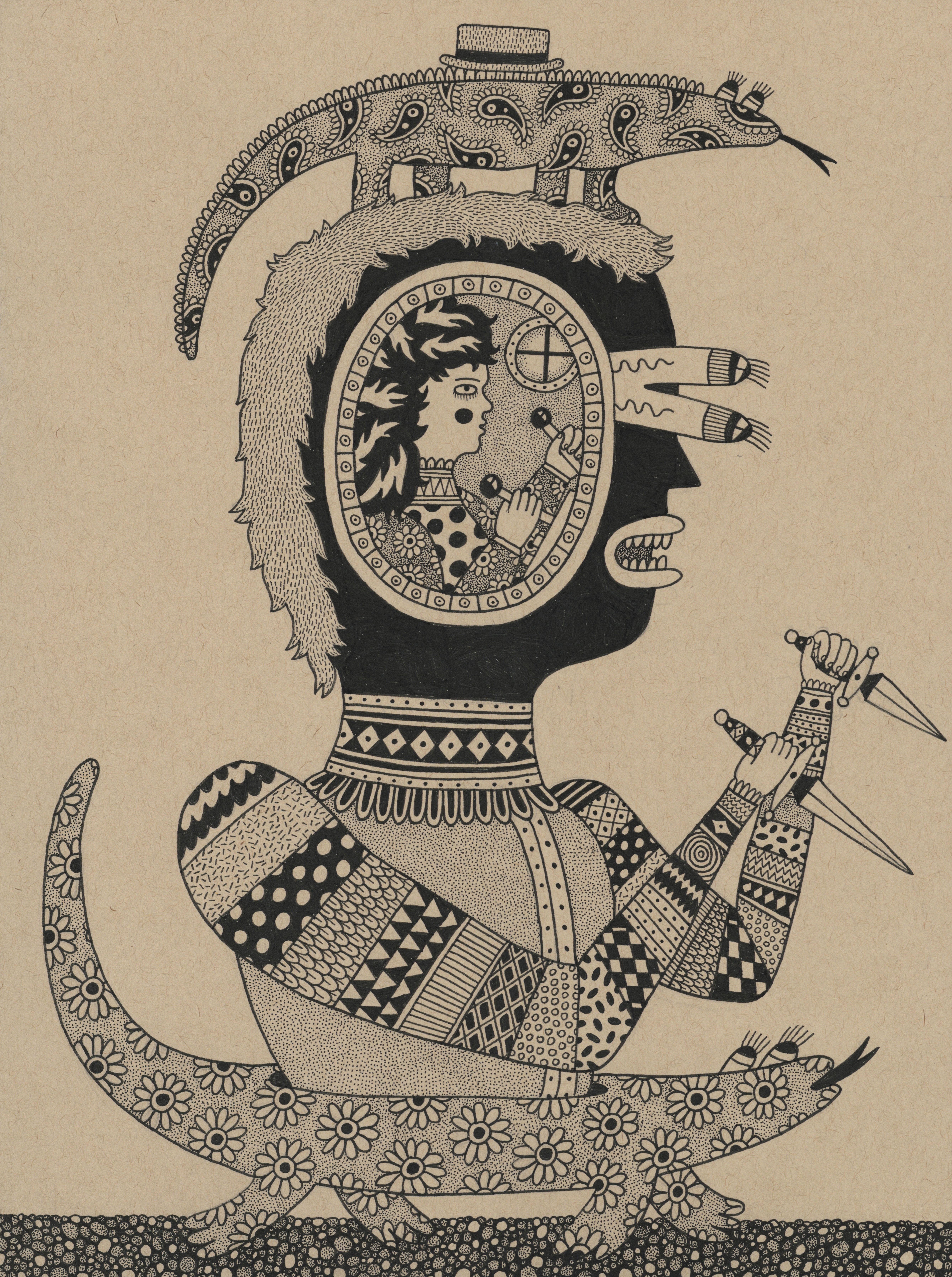
In “Stabatron,” Vochatzer draws a person holding two knives being controlled by another figure manipulating the gears from inside their head. Lizard creatures are included as both carriers and passengers in the drama; their meaning all the while elusive. The viewer is left to wonder whether their inclusion is simply an example of the artist’s mind drifting creatively and the embracing of the corresponding element of chance.
There is an undeniable component of playfulness and joy in these works despite the drawings’ sometimes ominous themes. There is a concomitant conveyance of elements offering happiness and positivity; smiles and a collective exploration and camaraderie among the creatures themselves. The concept of play, in general, is central to the works. Vochatzer credits the Surrealist and Dada movements as influences. The belief in autonomism and denigrating of planning, while allowing the unconscious to guide the artists’ hand, are hallmarks of both movements. These drawings originate with less intentionality and should be viewed with the knowledge that most were made while Vochatzer was gallery sitting and composed without preparatory sketches; hence, the resulting ambiguity of meaning. The resulting compositions often project humor because Vochatzer’s exaggerated creations are placed in fanciful vignettes, making it impossible to take them seriously; they reflect the self-taught and whimsical traditions of folk art.
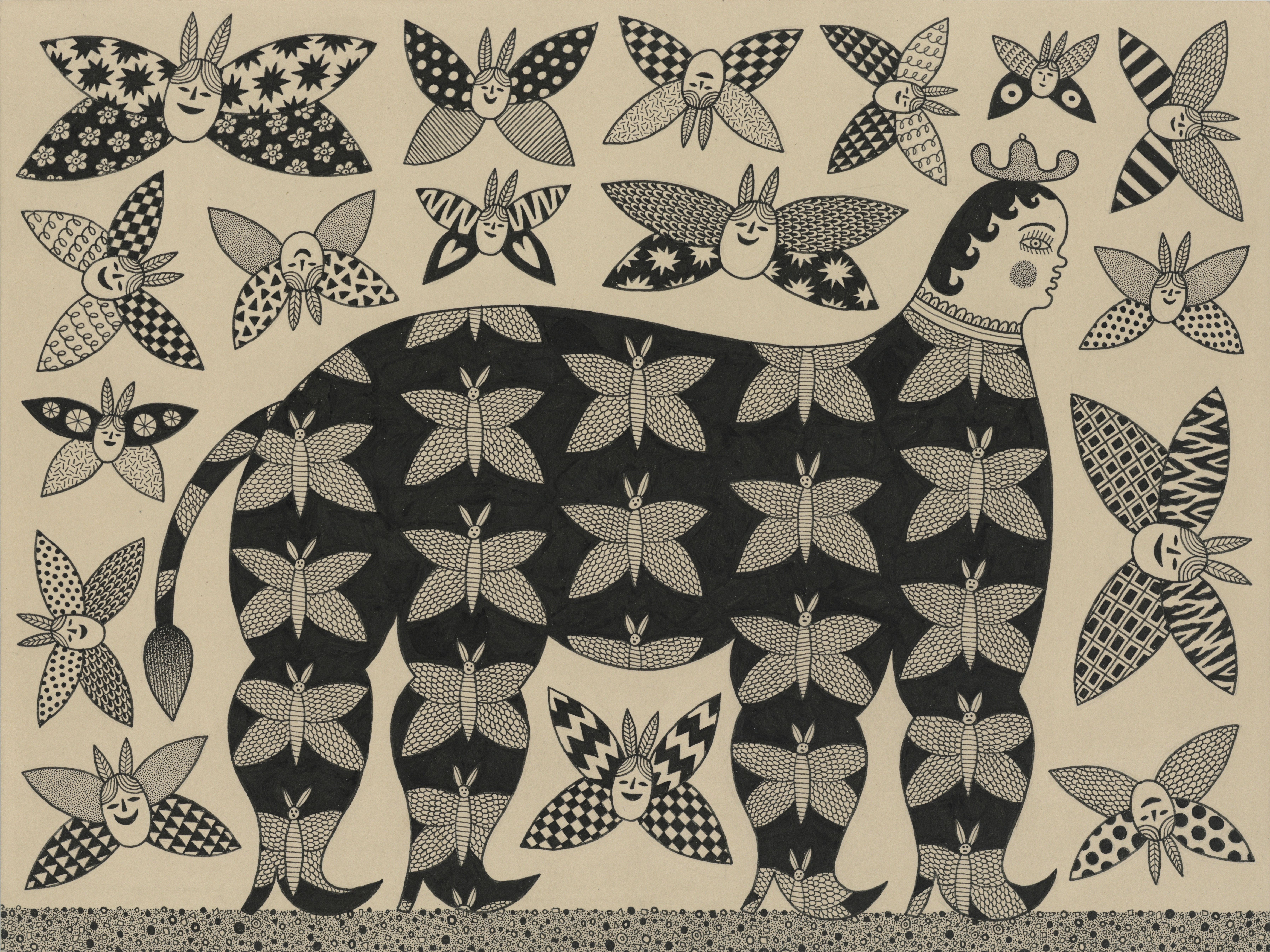
Despite his subconscious guiding the outcomes, Vochatzer’s perfectionism and obsessive-compulsive mind, notable in his previous oeuvre, sometimes comes to the foreground. However, it seems more aloof than what his previous work entailed because Vochatzer is minimizing the expectation and certainty of where the drawing is headed, the result being more abrupt, yet still satisfying. Here, the reliance on repetition consists of reiterating motifs and characters that inhabit a consistency that carries forth throughout the work, with outcomes reminiscent of the naivete and rawness of art brut.
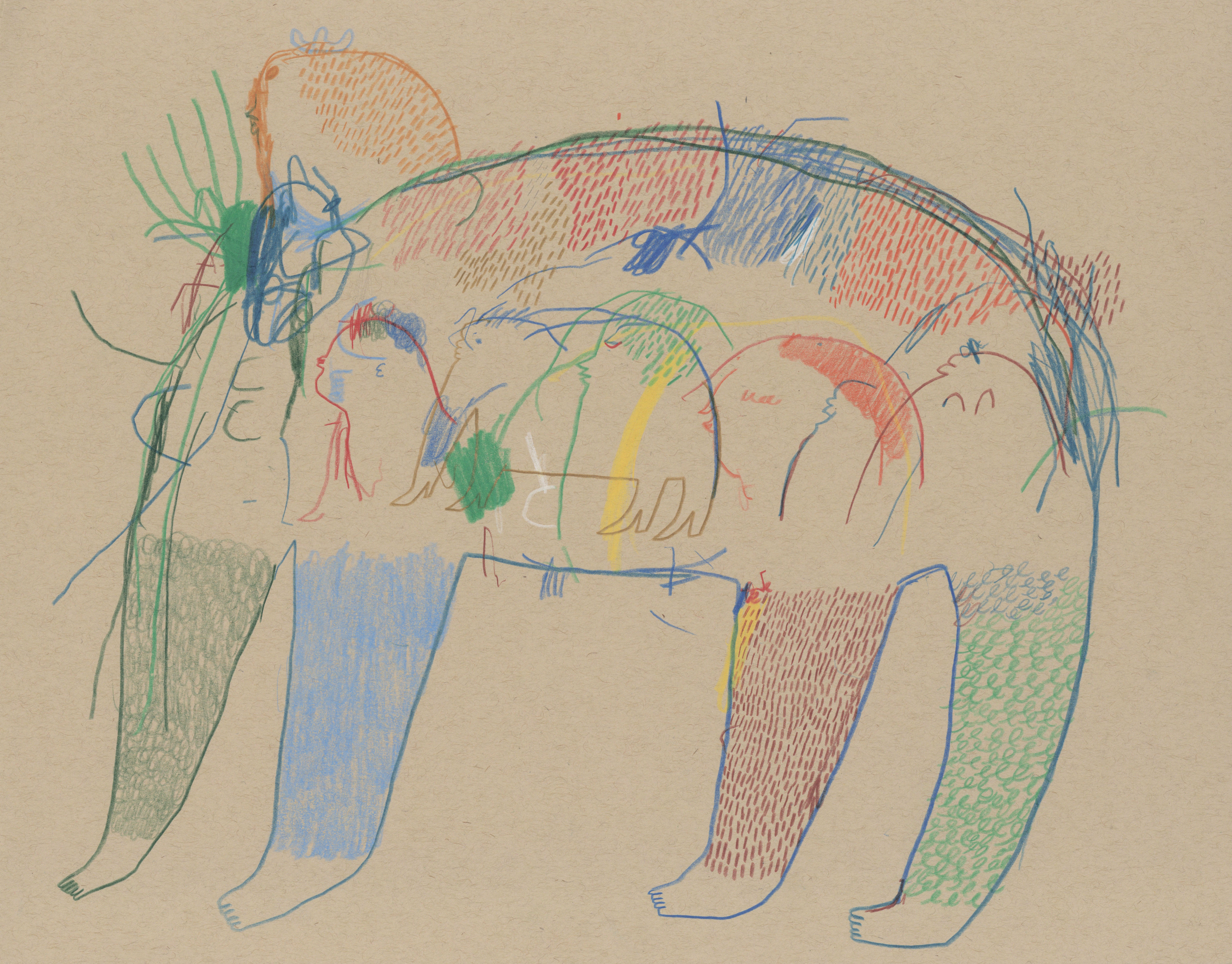
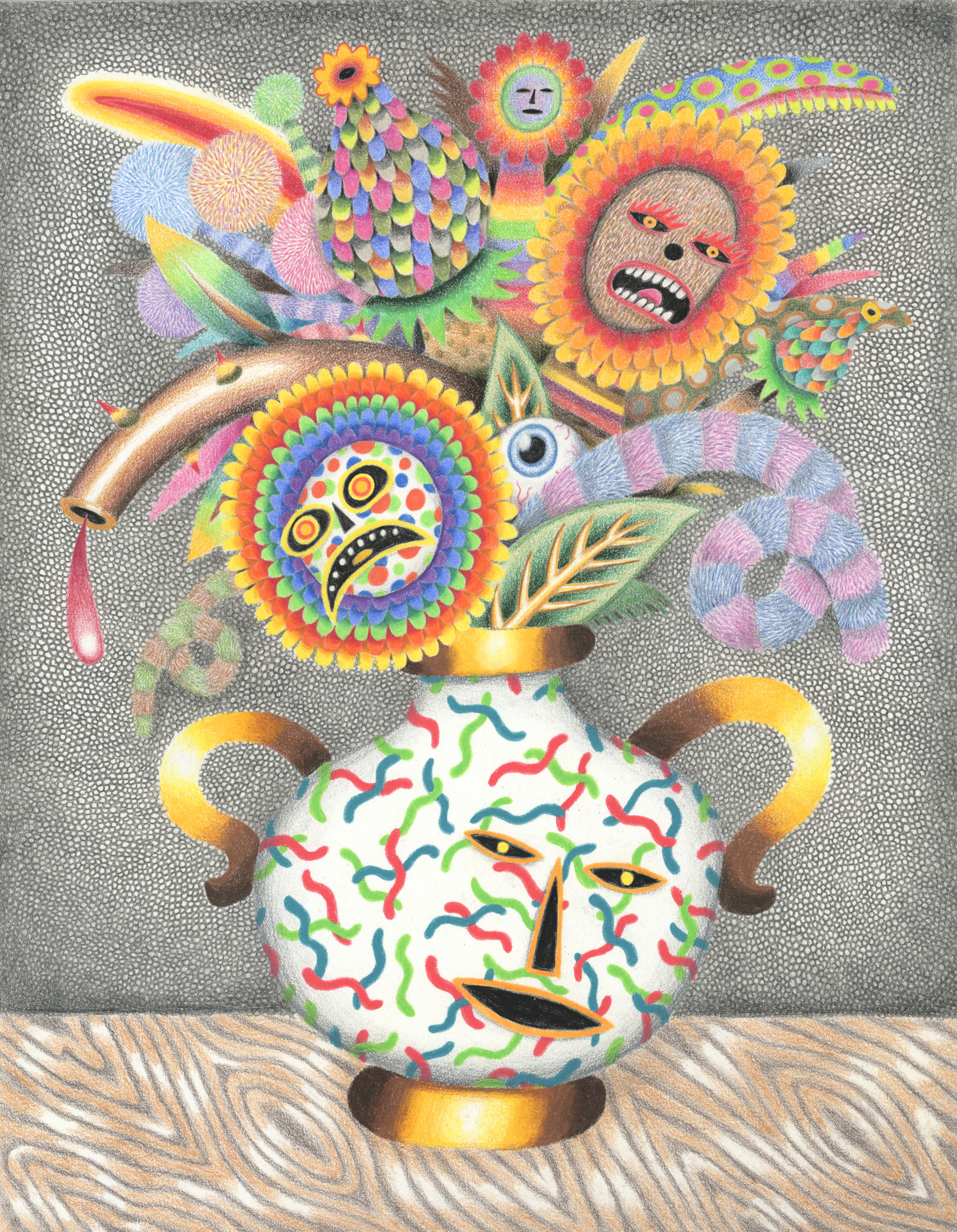
Most of the drawings are monochromatic which forces the most elemental engagement with composition. In a way, there is nowhere to hide behind in these works. The multiplicity of rendered characters and motifs keeps the viewer engaged and also makes the drawings feel very cohesive, as if Vochatzer’s own made-up world is fulfilled. The color works offer a respite from the simplicity of ink on paper. They flush life into the scenes depicted and the gradations of color keep the visual experience heightened.

To best appreciate these drawings the viewer should immerse themselves in the work; wandering and exploring the juxtaposition of the tighter versus looser drawings. The latter are particularly appealing because they feel as if Vochatzer’s control and restraint are at stake. By letting go, and allowing even more randomness and detachment, the resulting compositions are among the most compelling works. By being unresolved and rough, they allow for a different kind of alimentation; their complexity promises to sustain further over time. Their rawness is also captivating. It’s likely that the more frantic and chaotic pieces could only have resulted from a process that began with the more perfectionist and obviously refined works. “I Carry Them With Me,” “Strictly Business,” and “Walking Autobus” are examples of a wilder, haphazard, and even distraught drawing style which likely resulted as Vochatzer exhausted his innate and controlled repertoire.
In an age where art works are ubiquitous it is impressive and commendable that Vochatzer has created a unique visual library and experience for the viewer. These drawings adhere to the exploration of playful dream characters and spaces. They are made utilizing a bold drawing line which allows the viewer to experience new and invented microcosms of activity. Vochatzer has created a visual lexicon which shows us the debris he has found in the corner of his mind; the drawings are his effort to sweep them out.
–Matt Gonzalez



 Art & Politics: The Matt Gonzalez Reader
Leave a comment