first published in Roborant Review, January 2, 2026
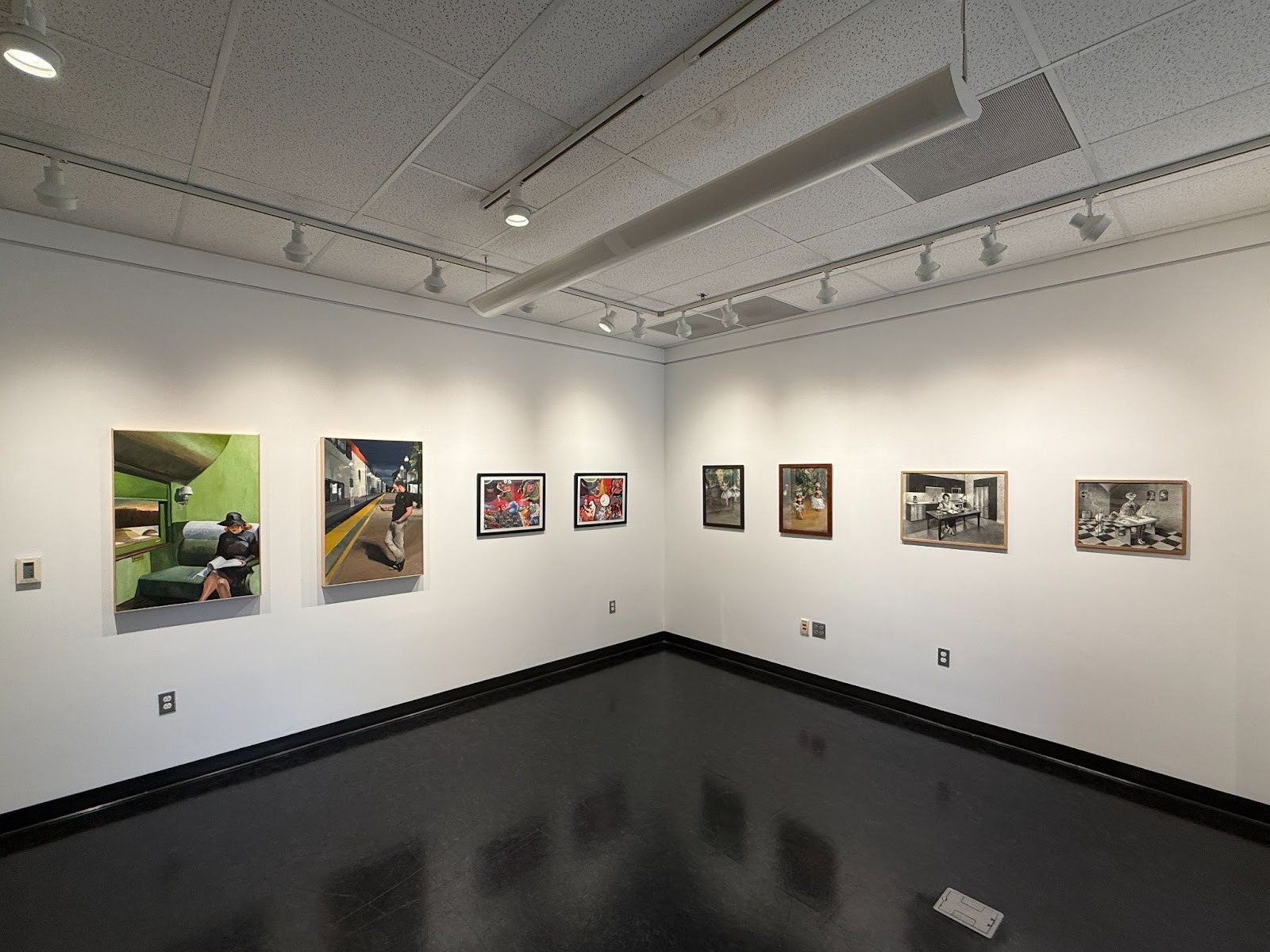
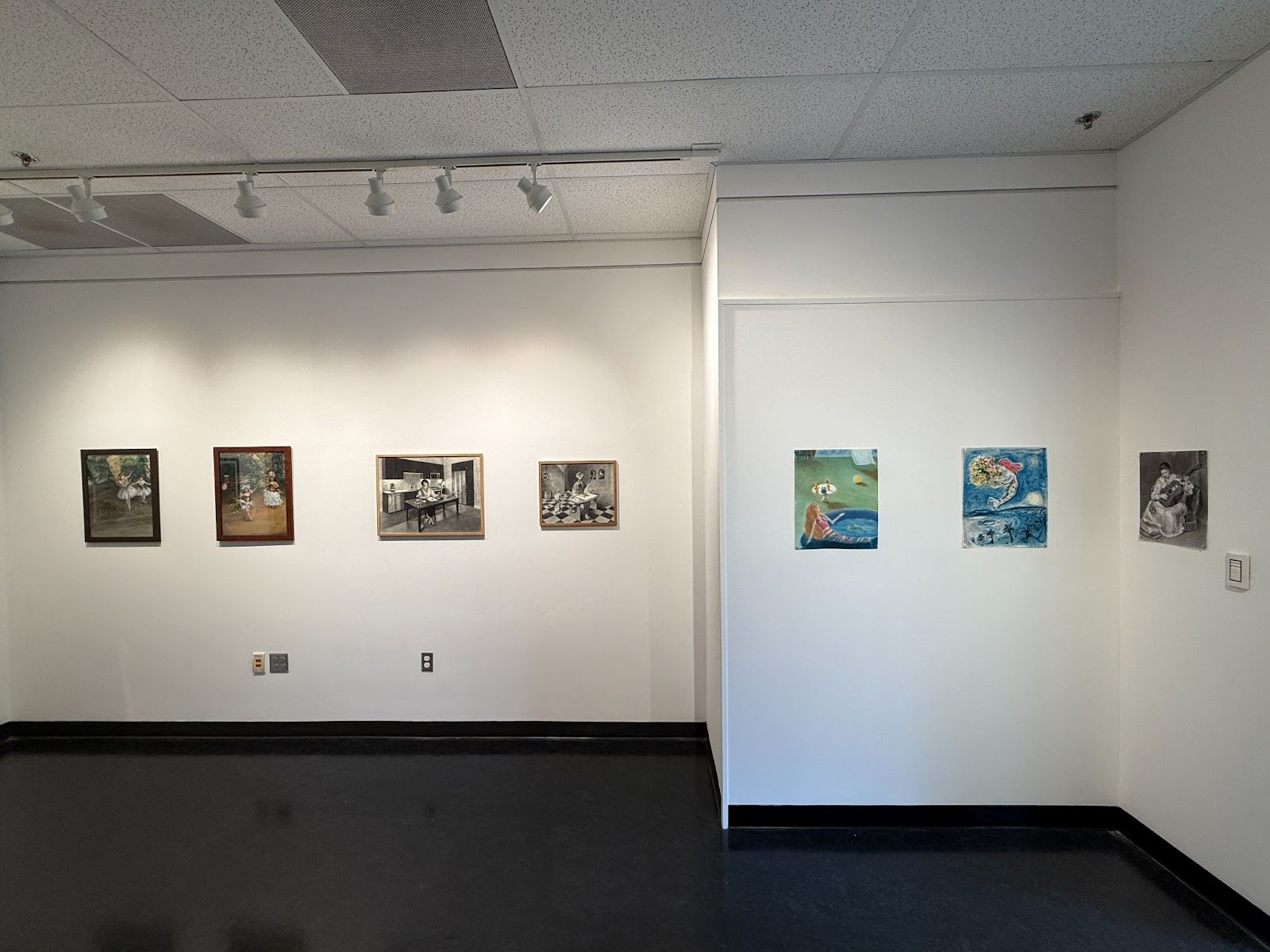
Installation photograph, Cañada College Art Gallery, all photos courtesy of Emilio Villalba.
Copying as Education, Student Group Exhibition at Cañada College Art Gallery, Redwood City, CA
By Matt Gonzalez
Cañada College Art Gallery
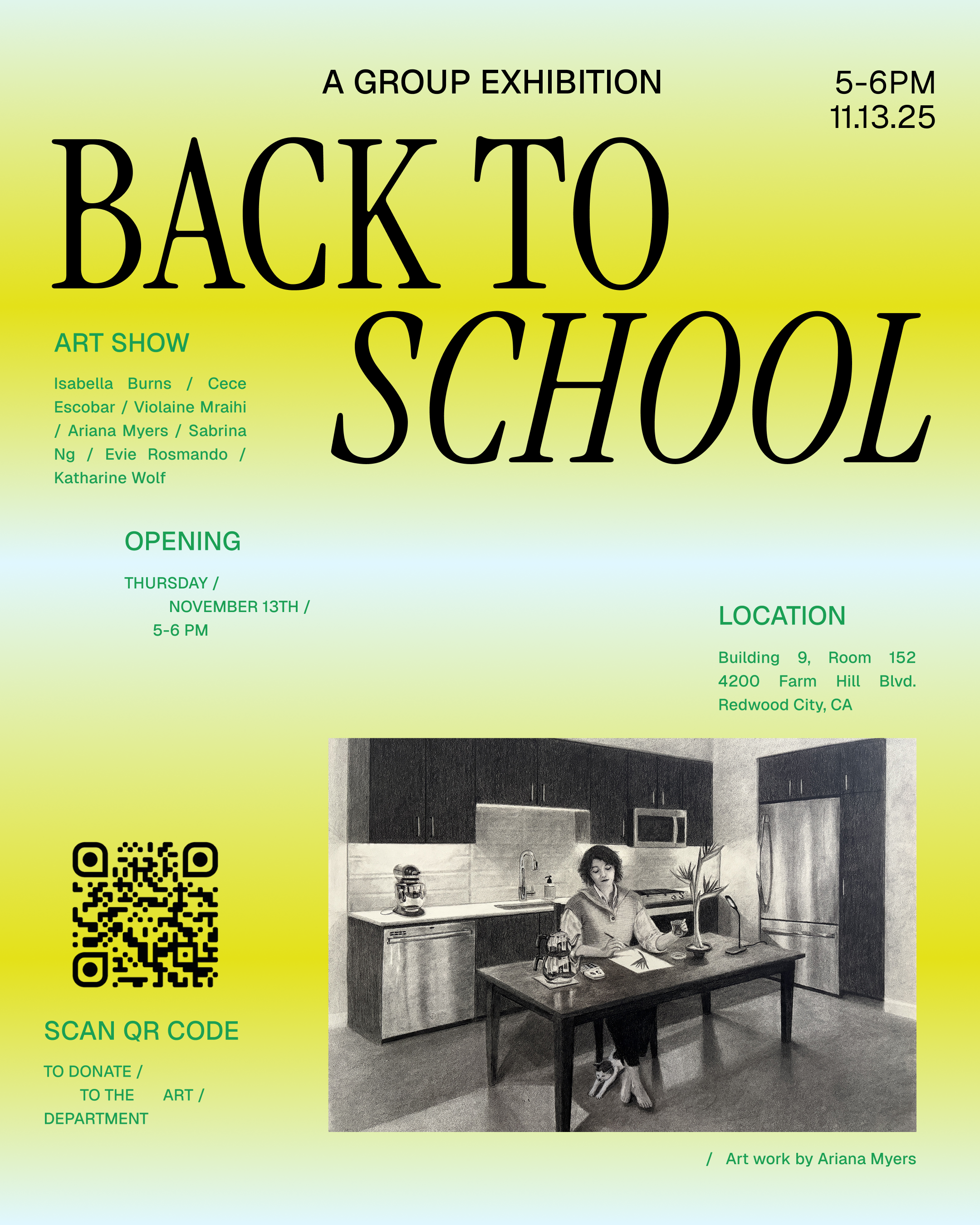
Back to School: A Group Exhibition curated by Emilio Villalba
Featuring Isabella Burns, Cece Escobar, Violaine Mraihi, Ariana Myers, Sabrina Ng, Evie Rosmando, and Katharine Wolf
November 13 through December 11, 2025
“I can assure you that making copies interests me enormously, and it means that I shall not lose sight of the figure, even though I have no models at the moment.”
“Many people do not copy, many others do – I started on it accidentally, and I find that it teaches me things, and above all it sometimes gives me consolation.”
-–Vincent van Gogh, two excerpts from a letter to his brother Theo, September 19, 1889.
It has long been a tradition among painters to copy the work of other recognized artists, as a means of study and skill development. Vincent van Gogh famously made copies of paintings by Eugène Delacroix and Jean-François Millet and the Louvre Museum was once opened to aspiring painters who were allowed to bring their easels and paints into the museum and spend weeks copying masterpieces from the collection (it is one reason the 1911 theft of the Mona Lisa took over 24 hours to be discovered, the public had considerable access to the collection). Paul Cézanne, who was himself a copyist, made an eloquent analogy about the custom, speaking of the Paris museum’s practice, “The Louvre is the book from which we learn to read.”
In keeping with this tradition, Emilio Villalba, an Assistant Professor of Studio Arts at Cañada College (in the Humanities & Social Science Department), curated a (just completed) exhibition of student works, “Back to School: A Group Exhibition,” featuring seven students who were asked to copy a masterwork of their choice and thereafter create an original artwork inspired by the work; an effort Villalba hoped would “transform tradition into personal vision.” The seven featured student artists included Isabella Burns, Cece Escobar, Violaine Mraihi, Ariana Myers, Sabrina Ng, Evie Rosmando, and Katharine Wolf. Advanced promotion for the exhibition noted “The resulting works span a range of media, from charcoal and graphite to oil paint, with each artist presenting their mastercopy alongside their original interpretation. Together, these pairings reveal individual creative processes and demonstrate the enduring relevance of looking closely at art history.”
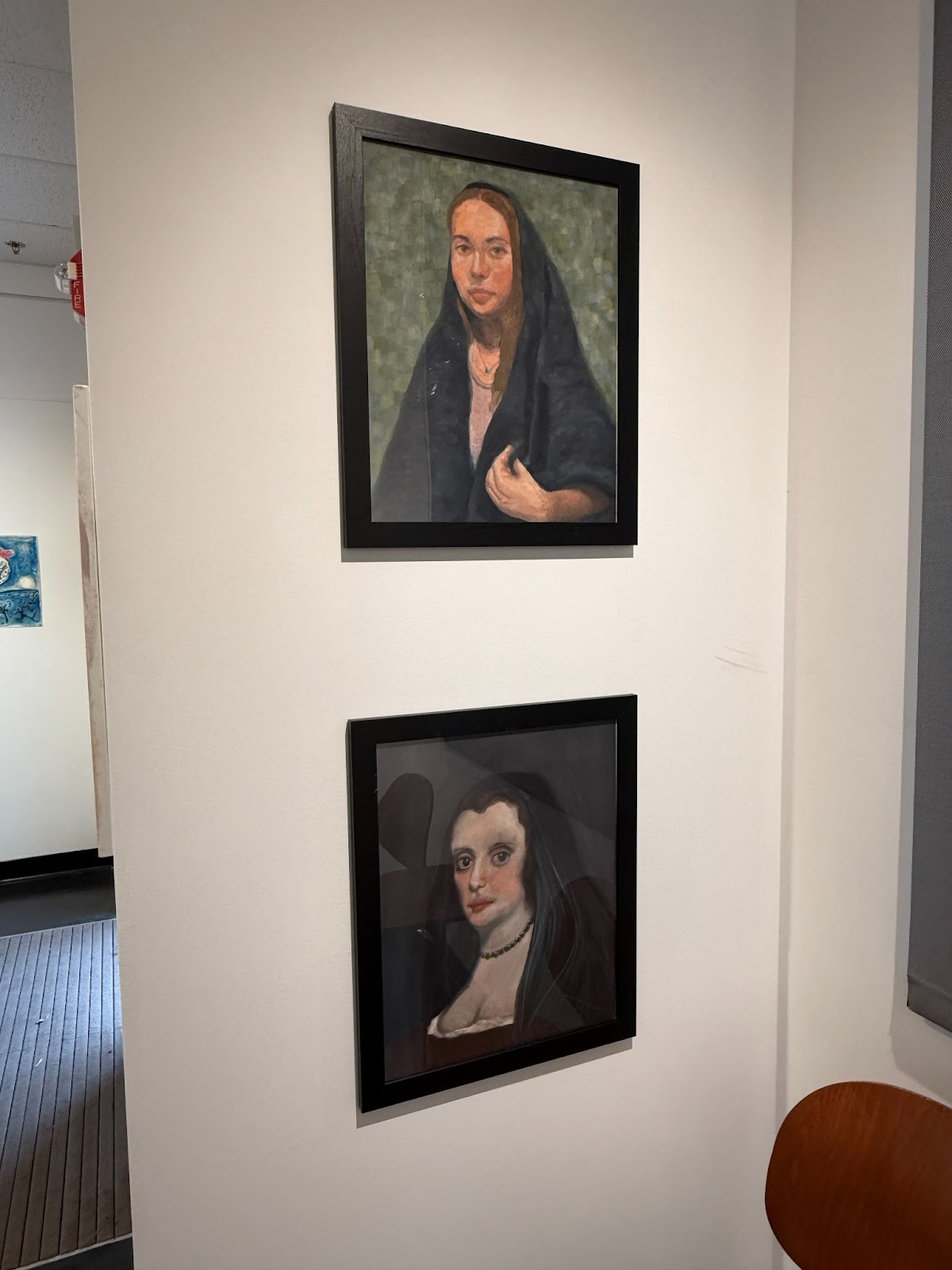
Isabella Burns, “Self-Portrait,” oil on paper, 16 x 20 inches, 2025; Isabella Burns, “The Lady with a Fan (after Diego Velázquez, c. 1640),” oil on paper, 16 x 20 inches, 2025.
Isabella Burns
Burns worked from a Diego Velazquez oil painting, The Lady with a Fan,” depicting a woman wearing a black lace veil on her head and a low-cut bodice and dark dress. Burns focuses on the upper torso of the figure, the original being a lengthier composition, and thereafter renders herself in a similar pose. Her original work, an oil on paper, lightens the background of the Velazquez painting and eliminates the lazy eye of the original sitter. She adeptly handles impasto to heighten the emotion she projects to the viewer.
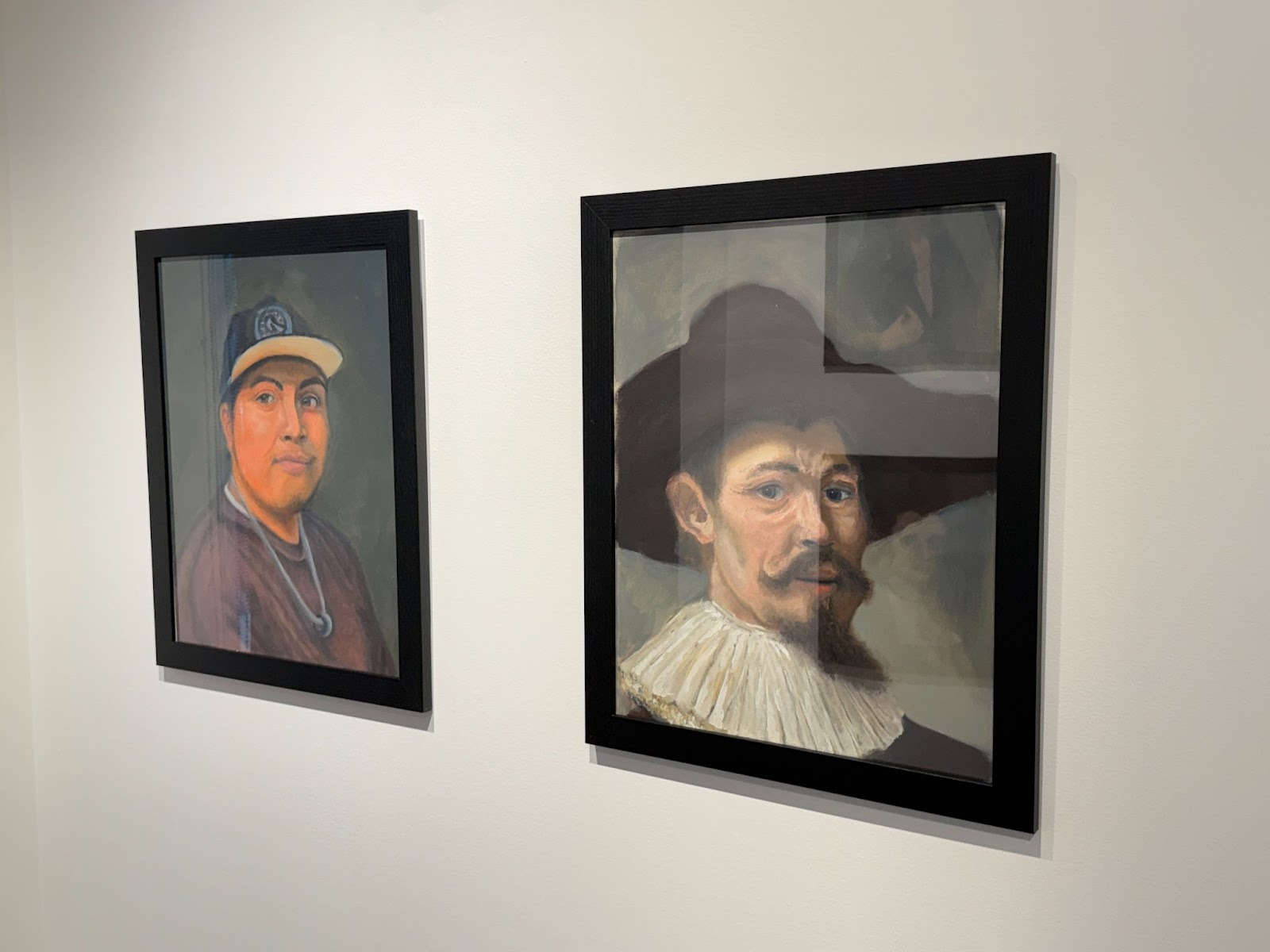
Isabella Burns, “Portrait of Jeo,” oil on paper, 16 x 20 inches, 2025; Isabella Burns, “Herman Doomer (after Rembrandt van Rijn, 1640),” oil on paper, 16 x 20 inches, 2025.
She also worked with a Baroque portrait by Rembrandt van Rijn of a successful Amsterdam cabinet maker, “Herman Doomer.” Again Burns prefers to shorten the portrait composition. She wonderfully captures the subject’s face and its enlivened, slightly open-mouth, expression. The rendering of the white ruff encircling Doomer’s neck, which was a common garment of the time, is particularly strong. Her accompanying “Portrait of Jeo,” is noteworthy for how casual it seems by comparison. Its knowing and confident expression coupled with baseball cap adornment stands in contrast to the dark, wide-brim hat Doomer wears and the seriousness it evokes.
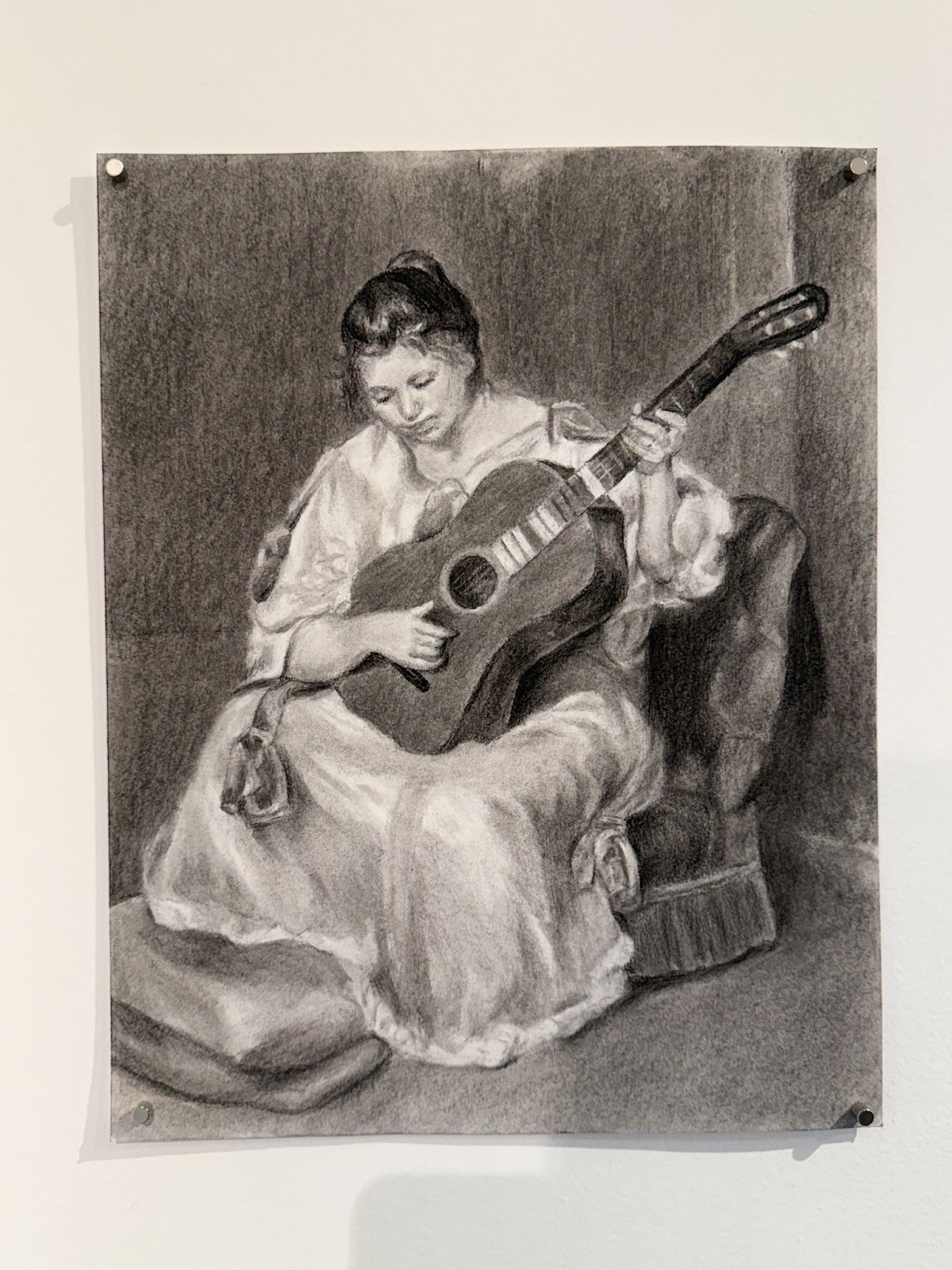
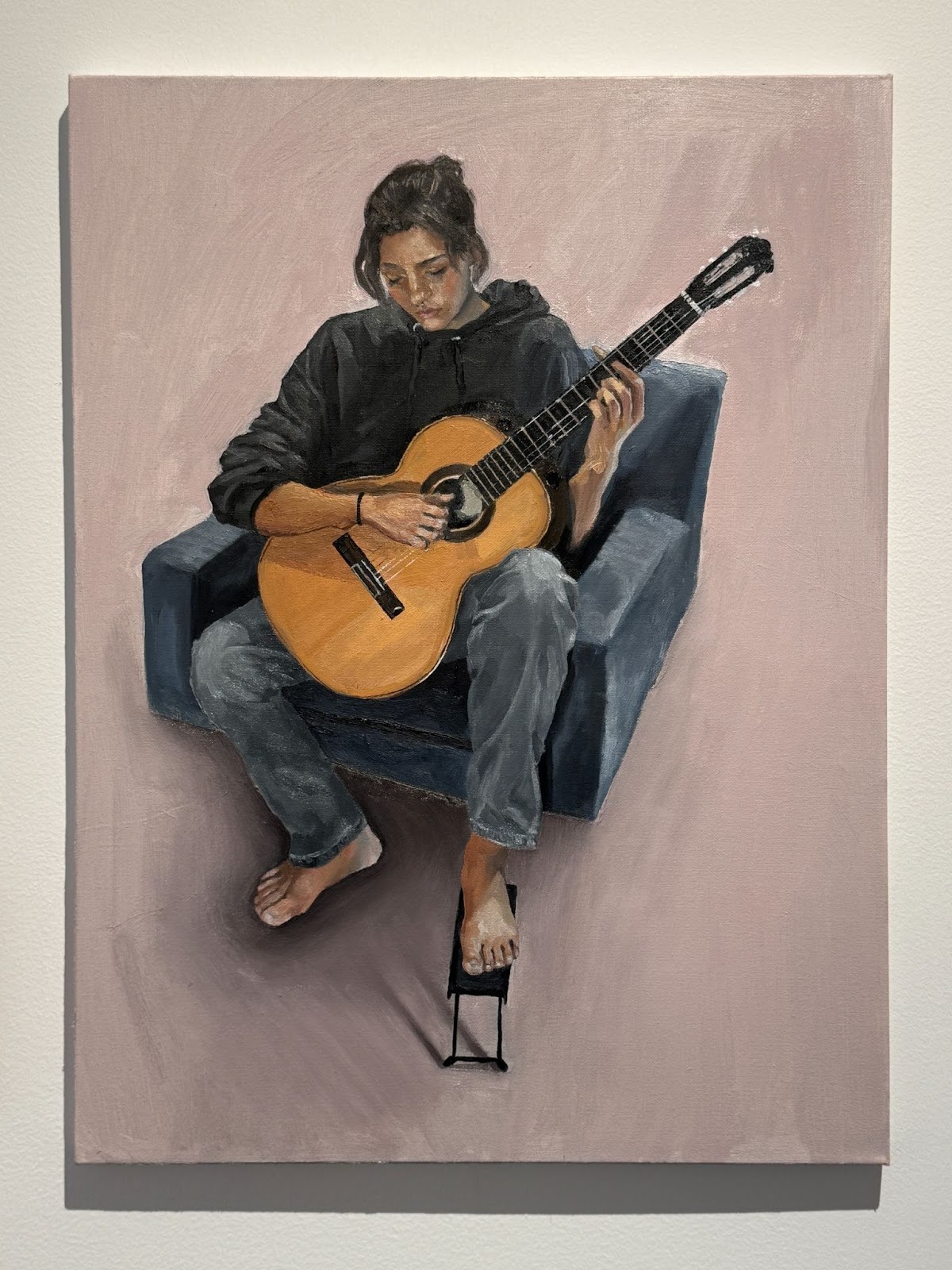
Cece Escobar, “Woman playing the guitar (after Auguste Renoir, 1897),” charcoal on paper, 14 x 11 inches, 2025; Cece Escobar, “Guitar,” oil on canvas, 24 x 18 inches, 2025.
Cece Escobar
Escobar renders one of Pierre-August Renoir’s woman guitar player’s which he painted in luscious pastel colors, highlighting the red earth tones, in a muted charcoal on paper work. Her handling of realism is strong, both the subject’s face is easily recognizable from the Renoir original and details such as the guitar’s frets and pegs, as well as the chair’s cushion tassels, are handled with skill. The charcoal medium choice loses the powerful color of the original, where pink ribbon bows heighten the contrast with the folds of the lighter-colored dress, but Escobar still conveys the sentiment of a guitar player focused on her technique and melody. In many respects, the carbon medium lends a gravitas to the moment.
Escobar’s original piece, titled simply “Guitar,” shows a familiarity with the form and her own experience as a classical guitar player, an instrument she has studied since she was two. Realism is rendered beautifully as the guitar player (a self-portrait) nurtures the guitar on her lap while seated in her own living room. Arms and legs are comfortable holding the guitar and presented confidently. A guitar foot rest, meant to reduce shoulder strain for seated players, is a poignant and realistic detail Escobar deftly chooses to depict in a composition stripped of non-essential figurative elements. The focal point is directed to the figure as the background is purposefully absent, painted in pastel tones with subtle shading. The texture of the blue jeans and the bottom ridge line of the sofa chair have particularly noteworthy realistic detail.
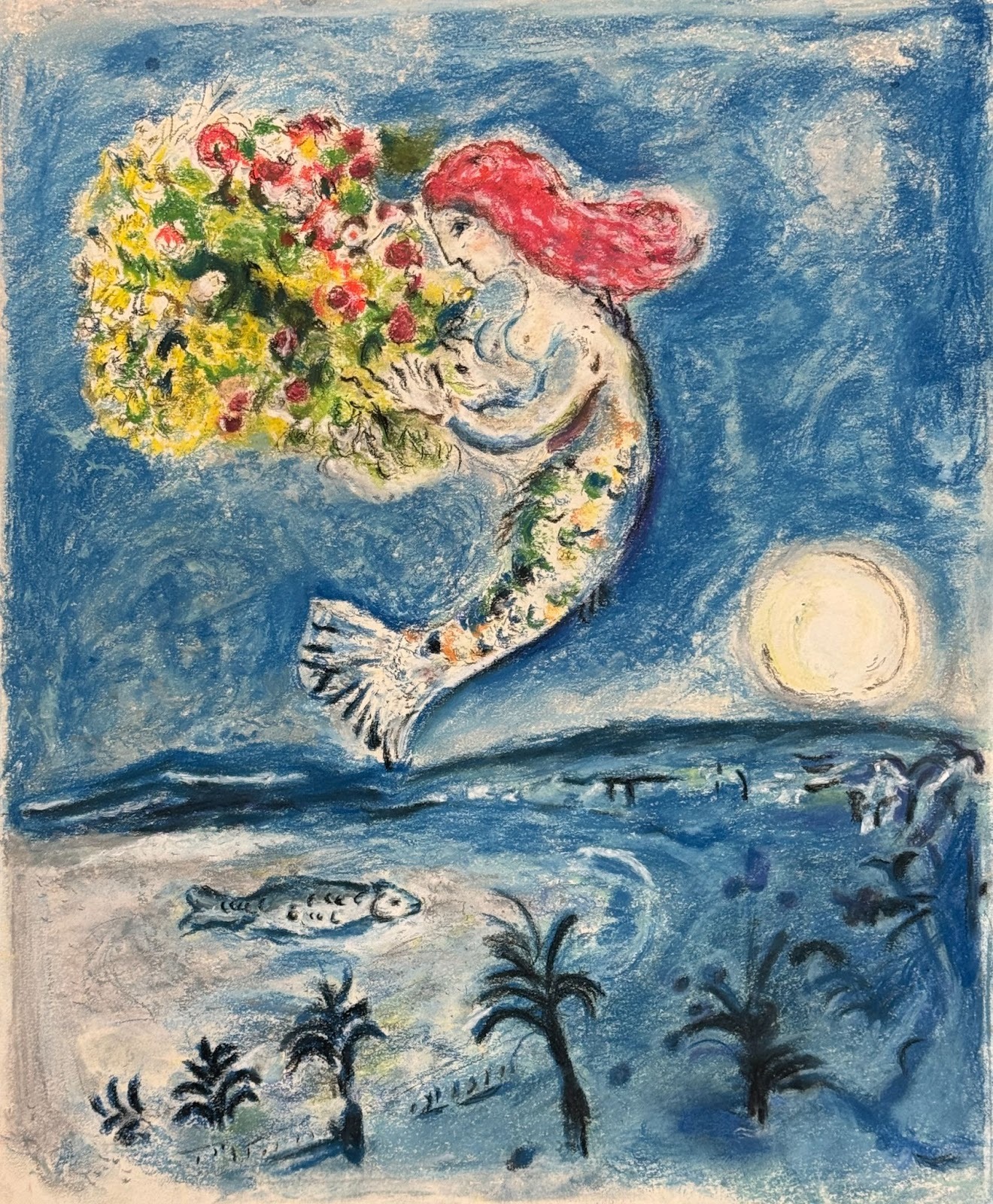
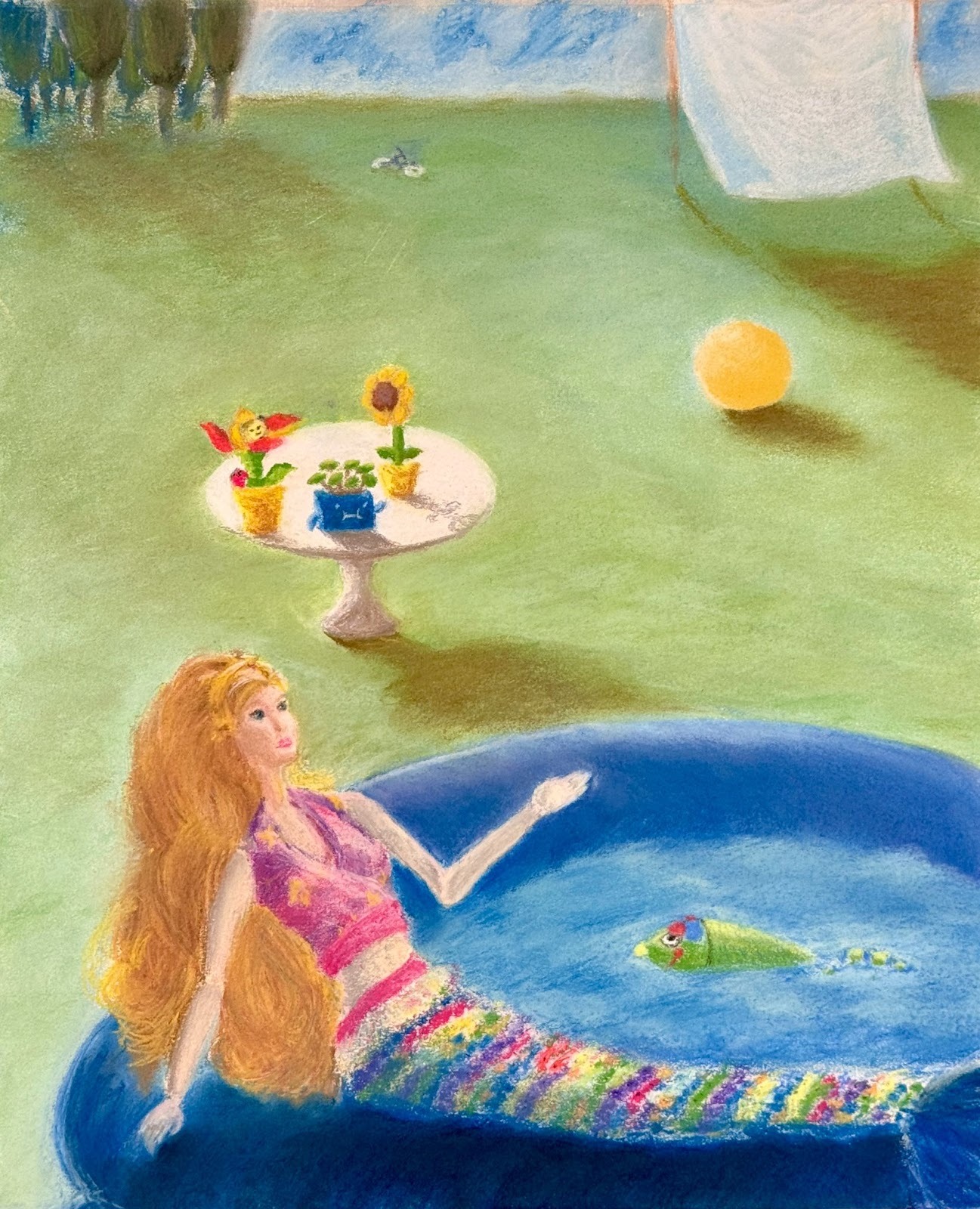
Violaine Mraihi, “Nice Soleil Fleurs (after Marc Chagall, 1961),” chalk pastel on paper, 17.5 x 14 inches, 2025; Violaine Mraihi, “Playground,” chalk pastel on paper, 17.5 x 14 inches, 2025.
Violaine Mraihi
Mraihi copied Marc Chagall’s chalk on paper work “Nice Soleil Fleurs” which could be translated as “Nice, Sunshine, Flowers.” Where Chagall focuses the scene from a distant perspective, making the picture about the city of Nice on the French Riviera, and its warm climate, Mraihi brings the composition closer into focus making the painting about a backyard activity of enjoying a smaller inflatable swimming pool. Her figure, what appears to be a mermaid doll, is rendered as a pool float, emphasizing a surreal quality to the entire scene as if a playground area has been abandoned.
Both have a frivolity about them, but Mraihi’s is decidedly more personal and less about celebrating an actual location. Both artists engage their work with doses of allegory. A fish appears in both, typically signifying abundance, yet here the viewer is left wondering what profusion they are being asked to contemplate. In Mraihi’s work, perhaps the significance is the wanting of things, in large measure.
The pastel colors Mraihi utilizes captivates the experience of an enchanting place, even if it is invented. A native of the coastal city Abidjan, Ivory Coast, one cannot help thinking the Mediterranean coast Chagall evokes must share some similarities with Mraihi’s homeland.
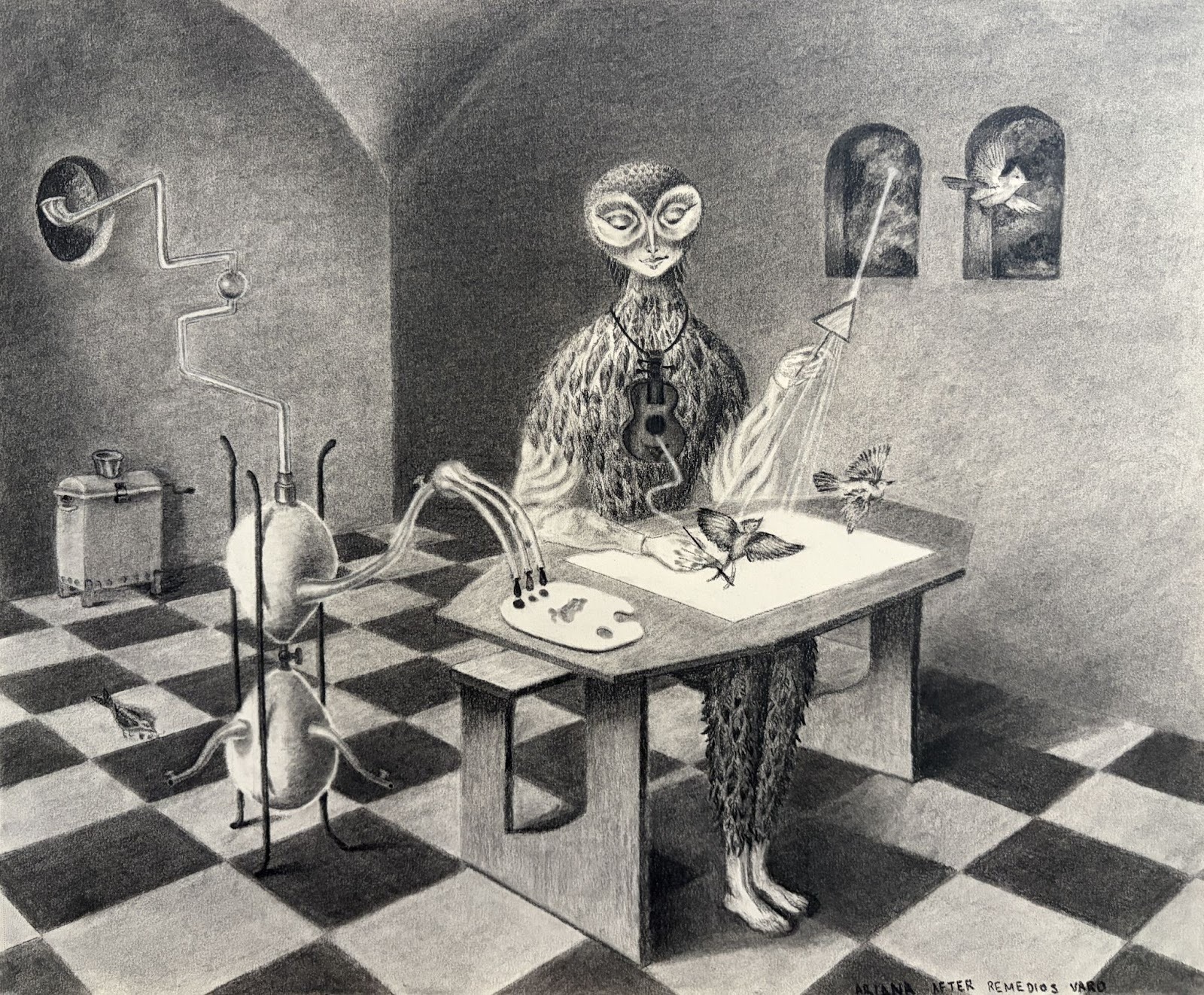
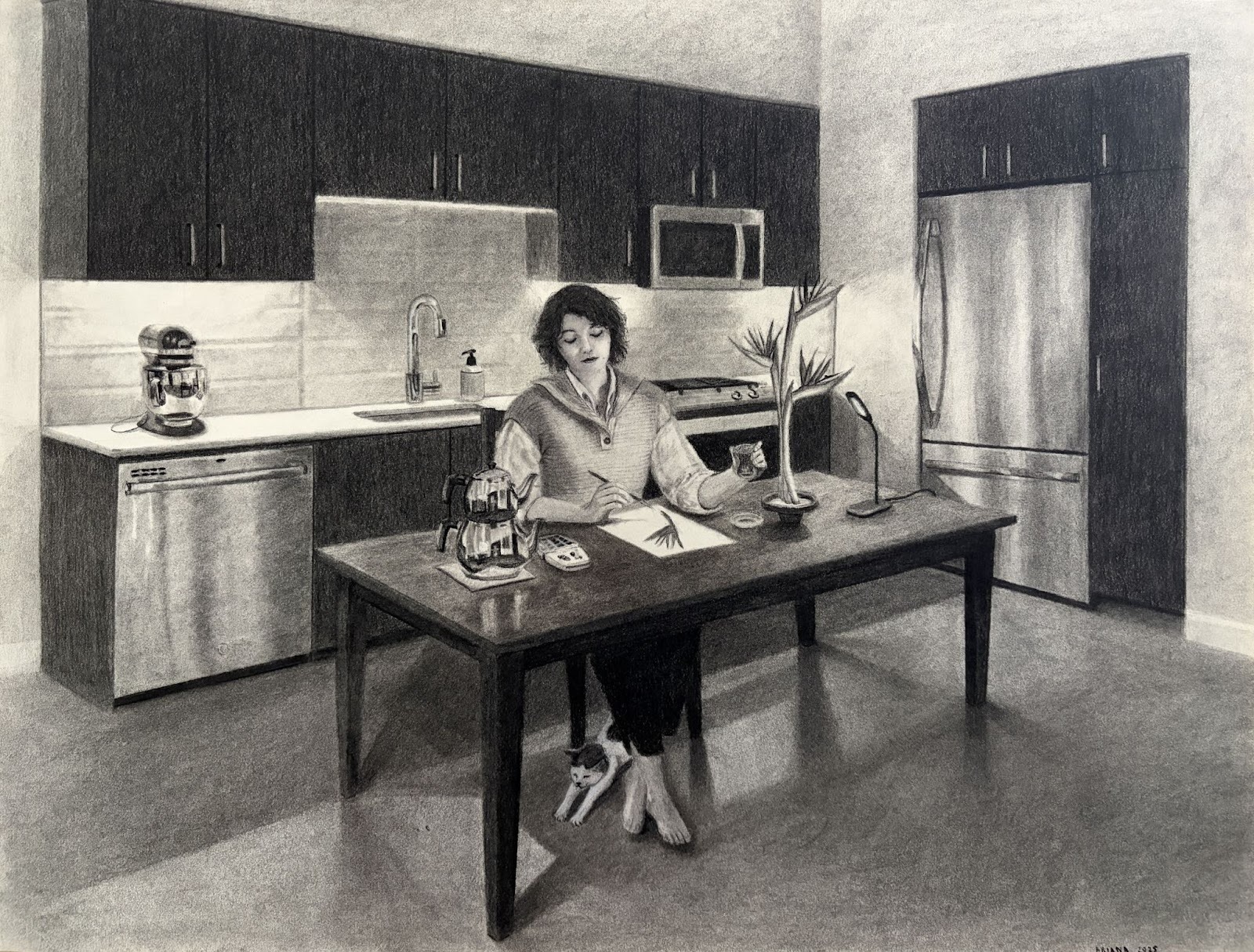
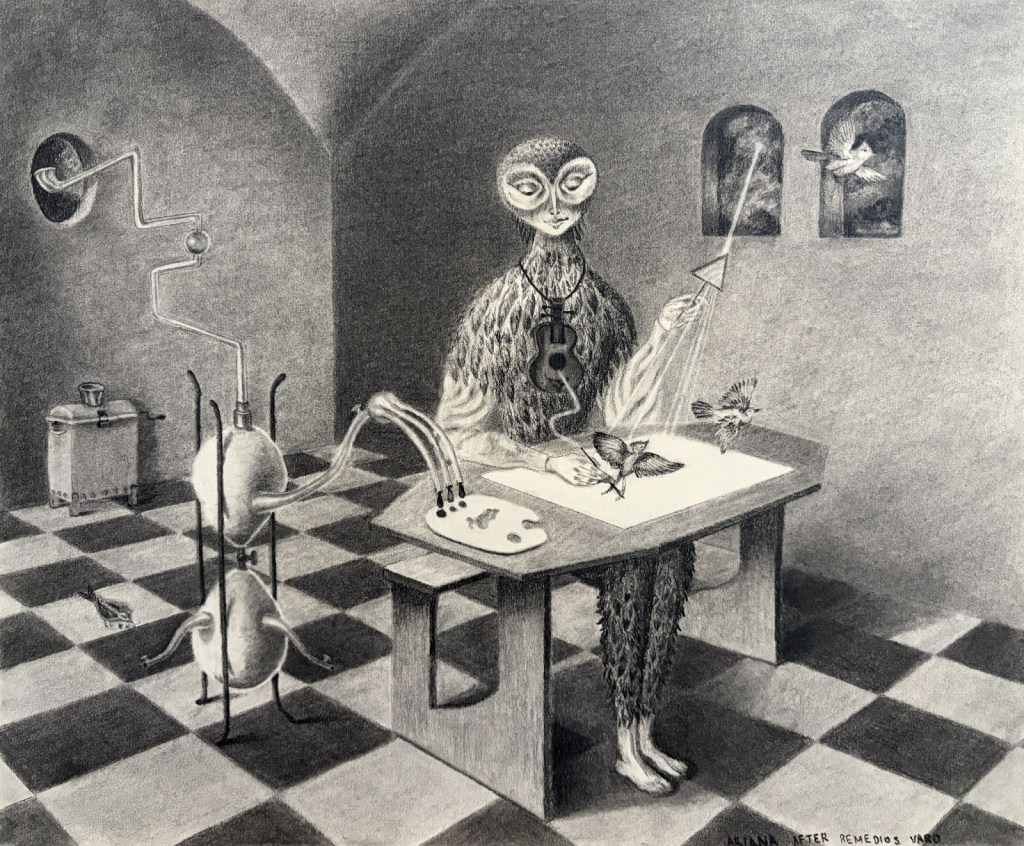
Ariana Myers, “Creation of the Birds (after Remedios Varo, 1957),”charcoal on paper, 14 x 17 inches, 2025; Ariana Myers, “Strelitzia reginae,” charcoal, 18 x 24 inches, 2025.
Ariana Myers
Ariana Myers worked with Mexican Surrealist Remedios Varo’s “Creation of the Birds,” an oil on masonite original from the late 1950s. It’s a painting rich in allegory and whimsical motifs. The original poses an owl-like figure cloaked in a feather-laden robe, working at a desk, making birds. The figure holds something, which has been suggested to be a violin bow but could also be a triangular pane of glass reflecting light, which plays some role in animating the birds with music or life itself. The painting, which seems to be about the artistic process and how artists imbue their creations with life-force, works because there are so many peculiarities to explore.
In Myers’ original work in charcoal, titled “Strelitzia reginae,” she channels her knowledge of botany, having previously obtained a B.S. in Plant Biology and worked as a researcher in the biotechnology field. She reimagines Varo’s work as a self-portrait in which she depicts herself drinking Turkish tea in her kitchen while painting Strelitzia reginae (known as the crane flower or bird of paradise, native to South Africa), a lovely and subtle call back to Varo’s “Creation of the Birds.”
The alchemical process and the various apparatus contraptions depicted in the original relate to Myers’ scientific inquiry yet she transforms the painting into one focused on a houseplant known for being low-maintenance and having strong ornamental qualities. But for the unusual examination of a leaf or stem from the nearby plant, the domesticity depicted stands in contrast to Varo’s original.
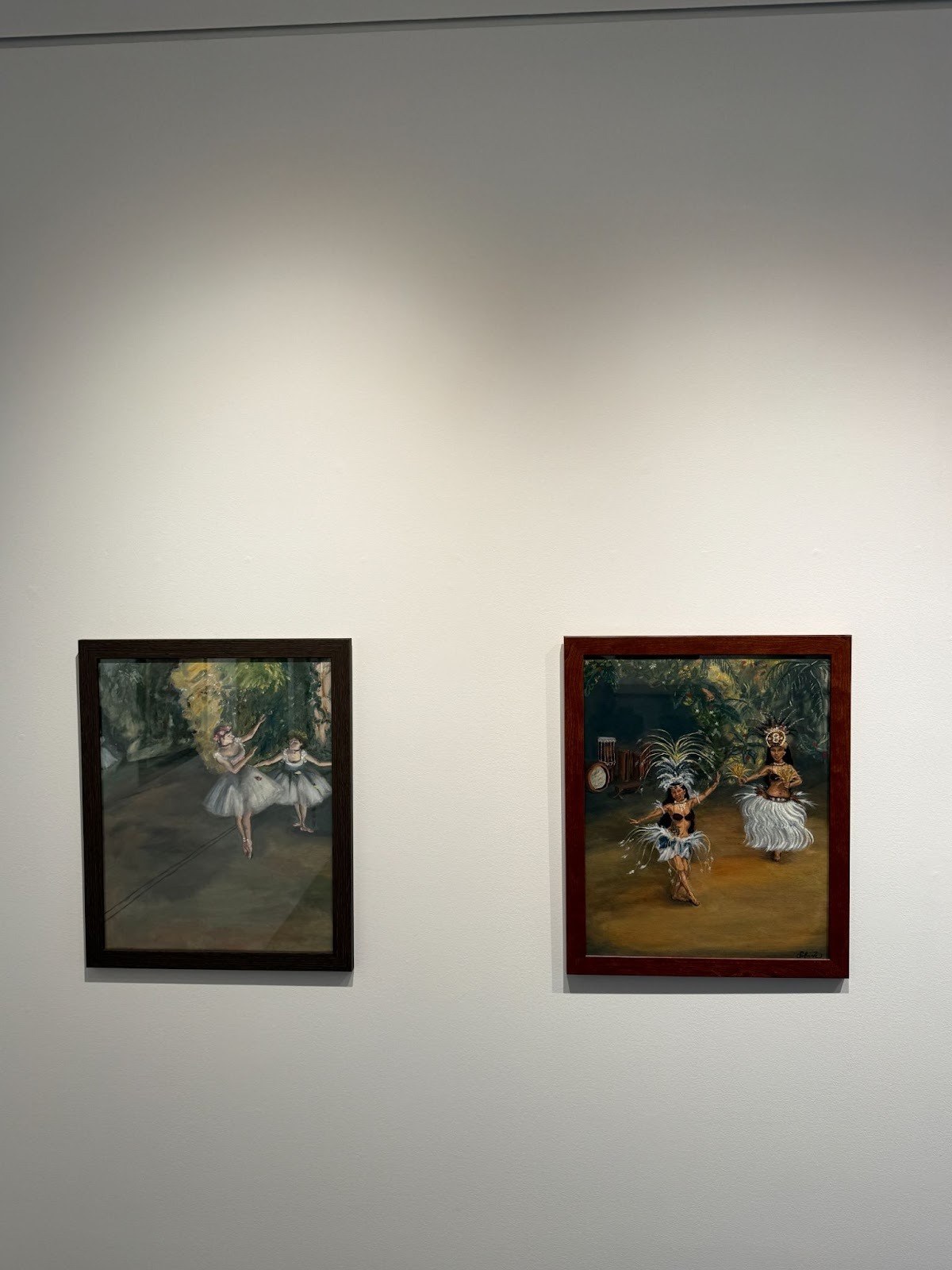
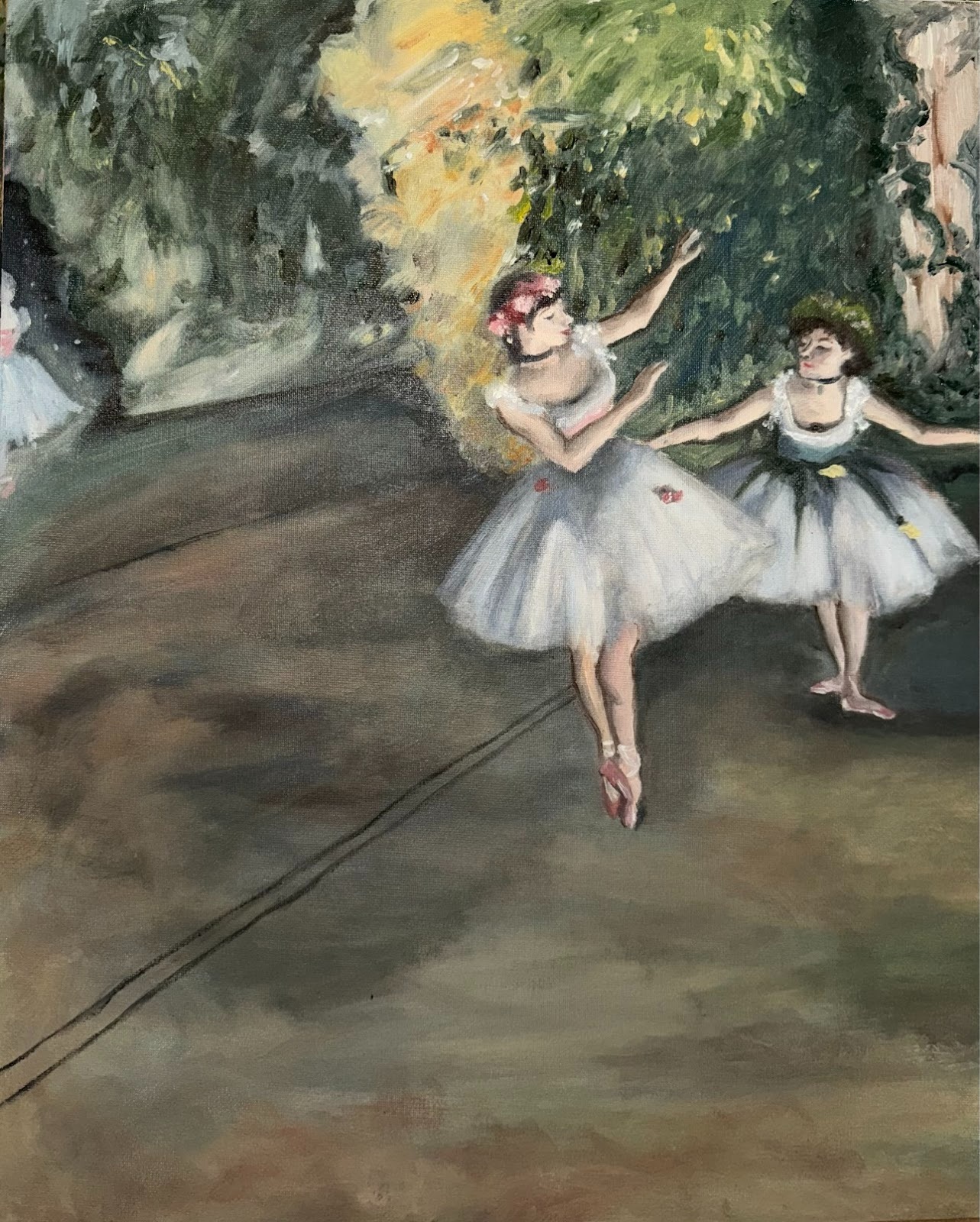
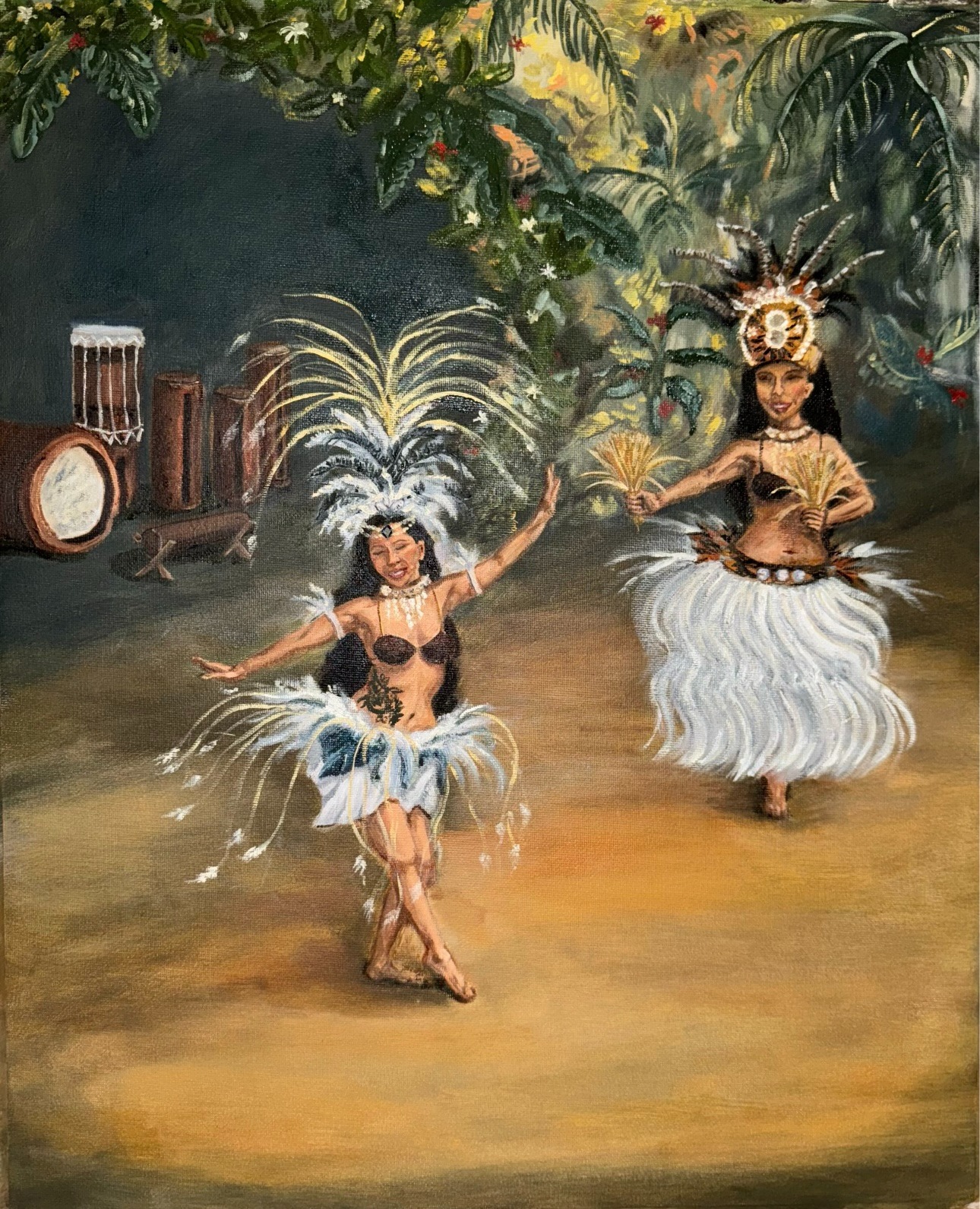
Sabrina Ng, “Two Dancers on a Stage (after Edgar Degas, 1874),” oil on canvas, 20 x 16 inches, 2025; Sabrina Ng, “’Ori Tahiti On Stage,” oil on canvas, 20 x 16 inches, 2025.
Sabrina Ng
Sabrina Ng reproduced one of the many Edgar Degas paintings of ballerinas he did during his lifetime. Despite what appears to be a stage action moment of two classical ballerinas performing, the partial presence of a third ballerina to the left of the composition suggests it is a rehearsal. Ng barely depicts that additional dancer, which accurately reflects the Degas original. We are privy to a vantage point that suggests the viewer is watching from the side of a stage, or perhaps from a slightly elevated balcony box. All of this is to say it conveys an intimacy, coupled with movement and grace, as the dancer in the foreground is en pointe, which relies on all the precision and poise of the regimental formality of classical ballet.
In contrast, Ng relies on her own experience as a dancer and her knowledge of Tahitian dance (‘Ori Tahiti) by reimagining the ballerinas as Tahitian dancers modeled after her own dance instructors. She, like Degas, renders the dancers mid-performance. But costumes, the placement of tropical plants, to’ere drums visible in the background, all reflect Tahitian culture and thus make that an equally compelling focus of the composition. Rather than depict only a single dancer in action, Ng renders both mid-gesture in festive garb and elaborate headdresses thus making “‘Ori Tahiti On Stage,” exude distinct action.
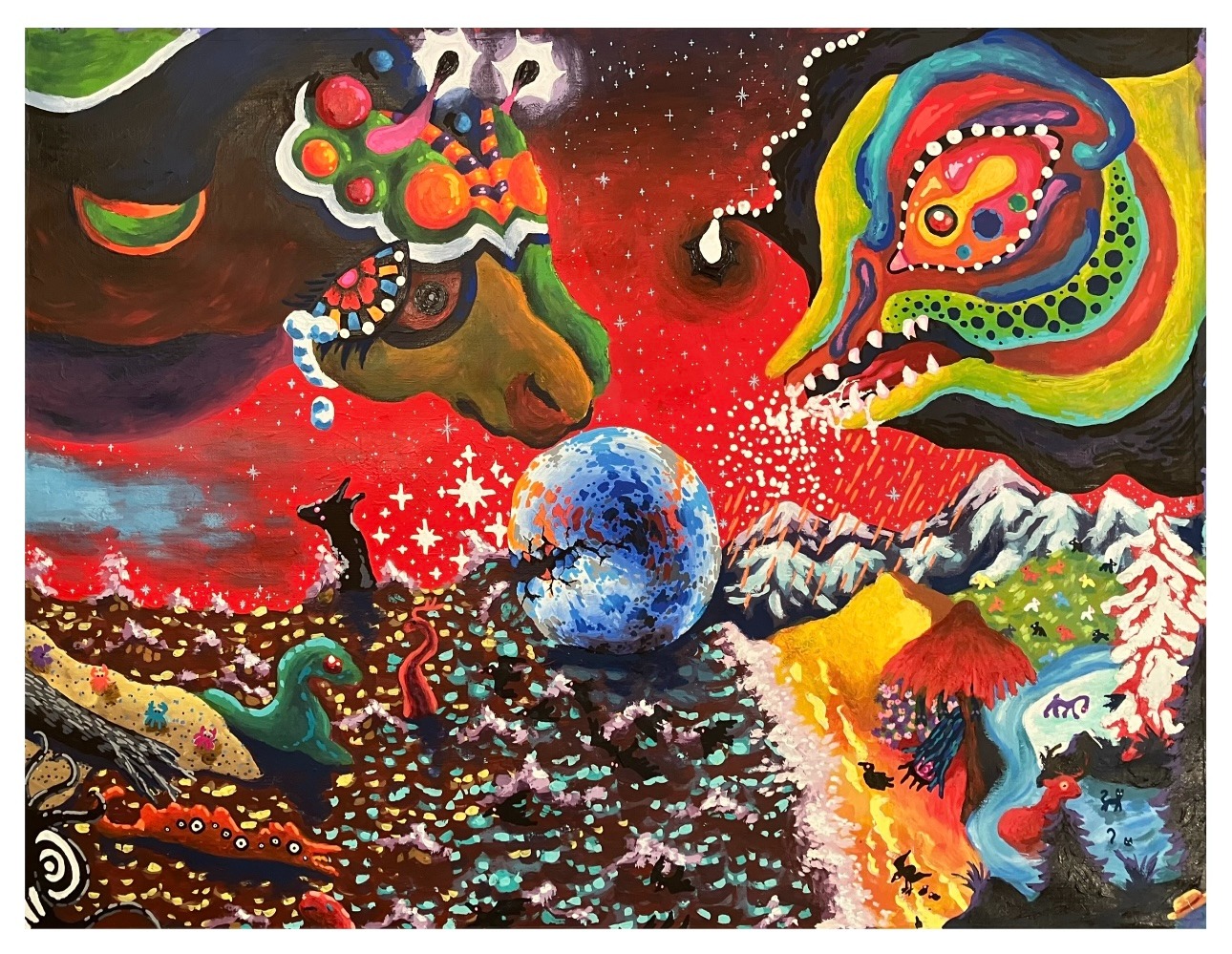
Evie Rosmando, “Results of Nugatio and Gaudium,” acrylic on canvas paper, 38 cm x 50 cm, 2025.
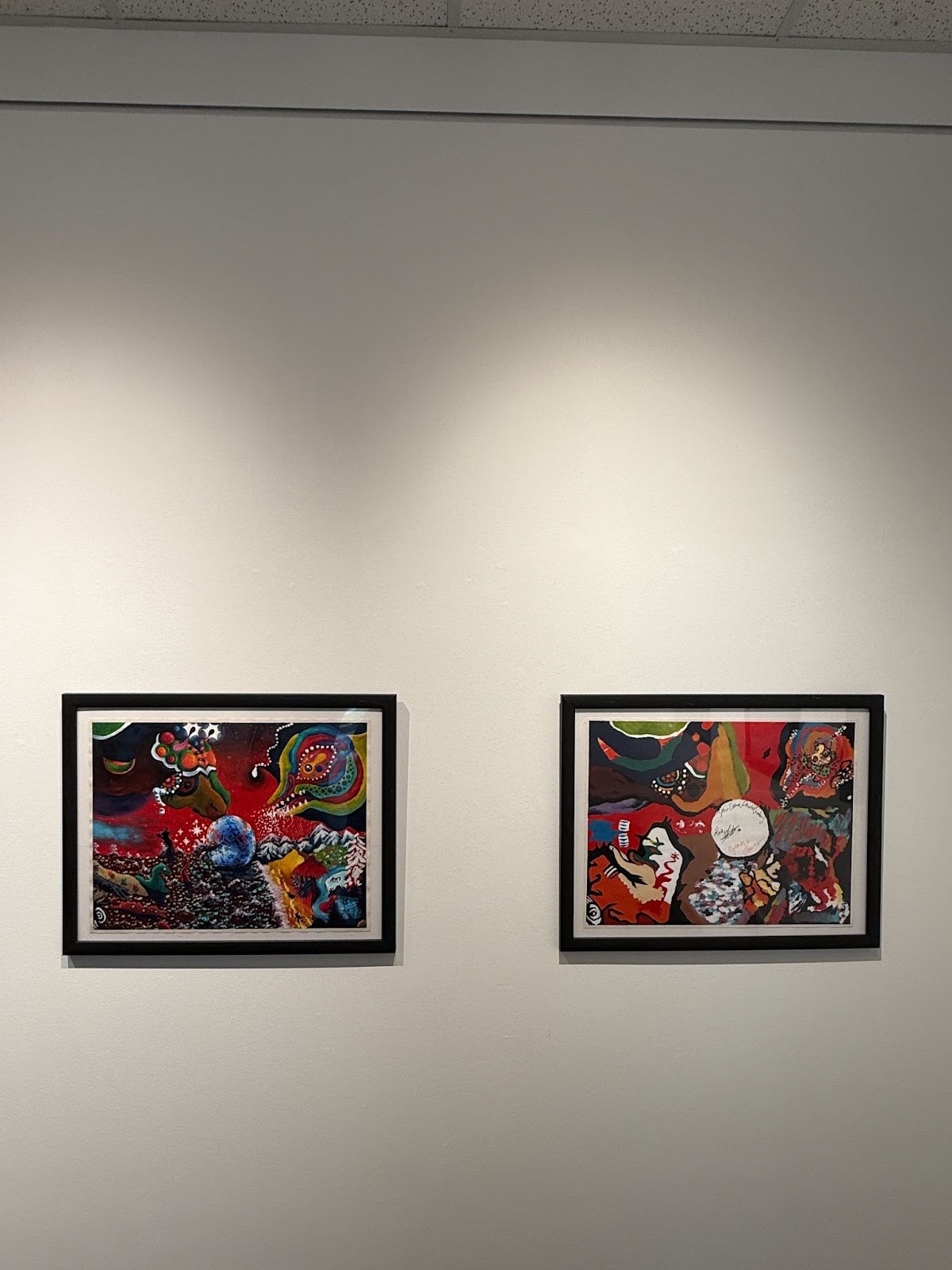
Evie Rosmando, “Results of Nugatio and Gaudium,” acrylic on canvas paper, 38 cm x 50 cm, 2025; Evie Rosmando, “Images of a Woman (after The Beatles: John Lennon, Paul McCartney, George Harrison, and Ringo Starr, 1966),” acrylic on canvas paper, 38 cm x 50 cm, 2025.
Evie Rosmando
Images of a Woman” was painted by The Beatles during a concert tour of Japan. Its oil and watercolor on paper with the circular element in the painting resulting from a desk lamp being placed there and later removed (the band placed their signatures there). Rosmando creates a truthful copy which is challenging given the abstract nature of the original. Importantly, despite its descriptive title, it does not contain figurative elements.
The painting Rosmando made in response, “Results of Nugatio and Gaudium,” is intriguing. There are two animal-like heads peering over the landscape watching over what looks like a blue, egg-shaped object. The title suggests that two entities did something or mix together to cause a result. “Nugatio” is an obscure Latin word meaning “chatter” or “the act of trifling,” suggesting focusing on inconsequential matters or even something without value. “Gaudium” seems to have a range of meanings around the concept of joy. Presumably these elements combined to inspire a symbolic narrative of how this world, the landscape presented in the composition, came to be or how it will be sustained. Rosmando placed their colorful egg in the white center of their composition, making for a stronger design choice.
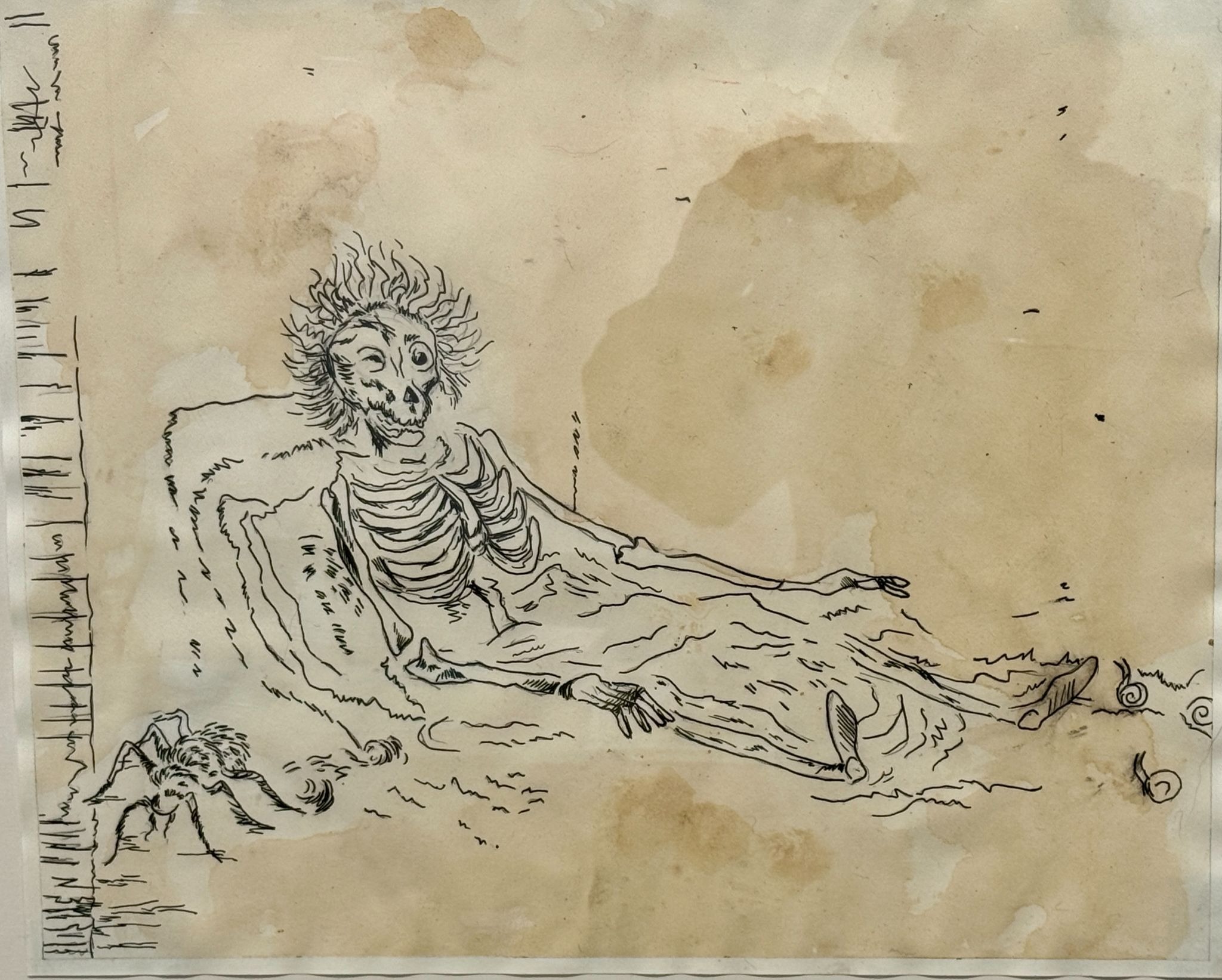
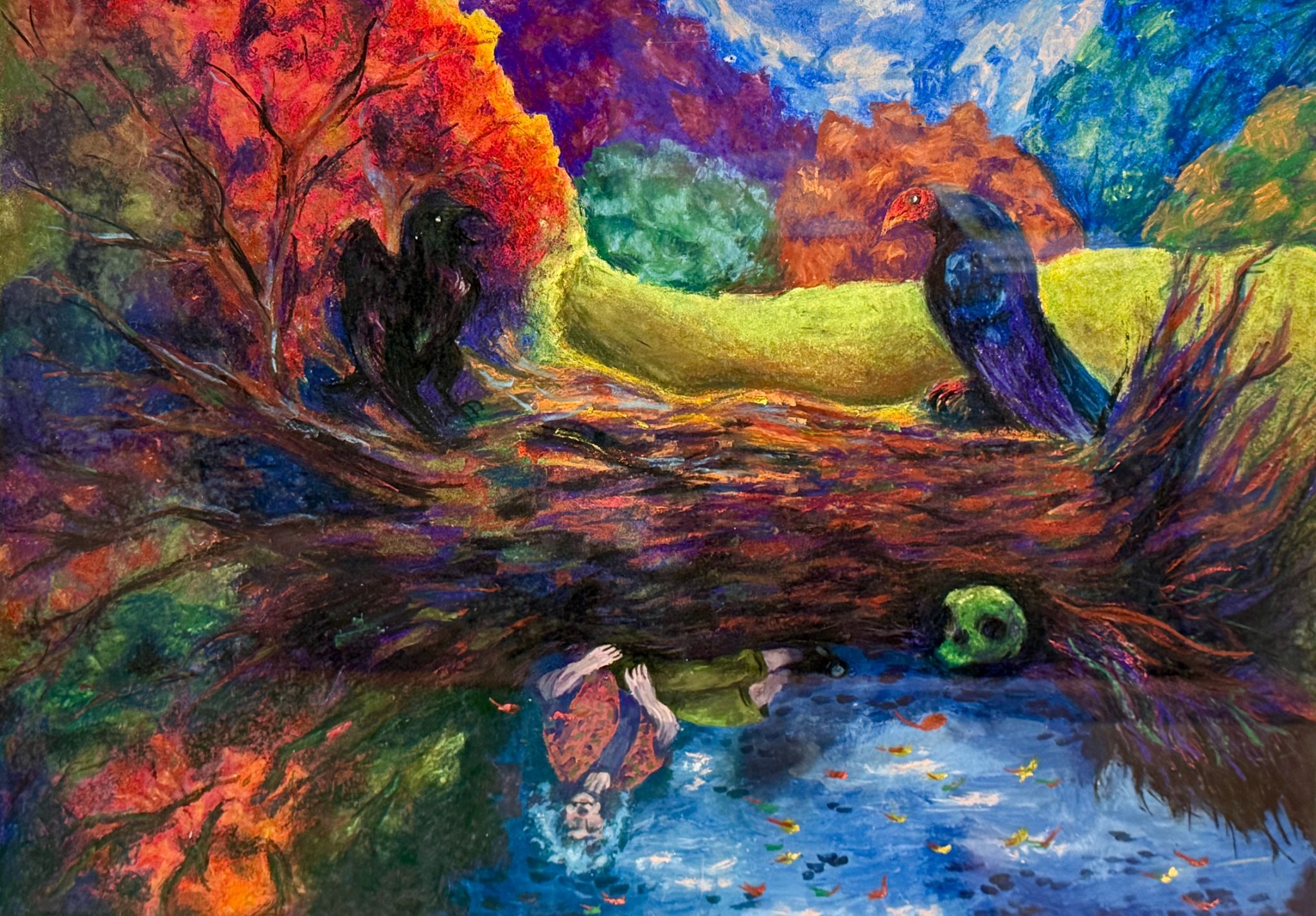
Evie Rosmando, “My Portrait in the Year 1960 (after James Ensor, 1888),” pen, tea, and coffee on paper, 13.5 x 15.5 inches, 2025; Evie Rosmando, “My Life or Otherwise in the Year 2106, acrylic on canvas paper, 17.5 x 23.5 inches, 2025.
Rosmando also worked with a second artwork, the etching “My Portrait in the Year 1960,” by Belgian painter James Ensor. In their faithful copy, Rosmando uses pen, tea, and coffee on paper, aptly capturing the macabre quality of the original. Ensor’s satirical self-portrait as a centenarian, depicts a skeleton in repose with a spider and snails lurking nearby. He is looking worse for wear, but conscious, though composed of only bones, ample hair strands protruding from his skull, wearing what look like night slippers.
In Rosmando’s version “My Life or Otherwise in the Year 2106” the aged figure appears comfortably seated on a fallen tree. Though oriented oddly, fully clothed and upside down, the figure seems quite content amidst the vibrant landscape with birds perched nearby, seemingly in conversation with one another. There’s ambiguity projected, at 100, Rosmando expects to be in harmony with the elements of nature, regardless of their healthful state.
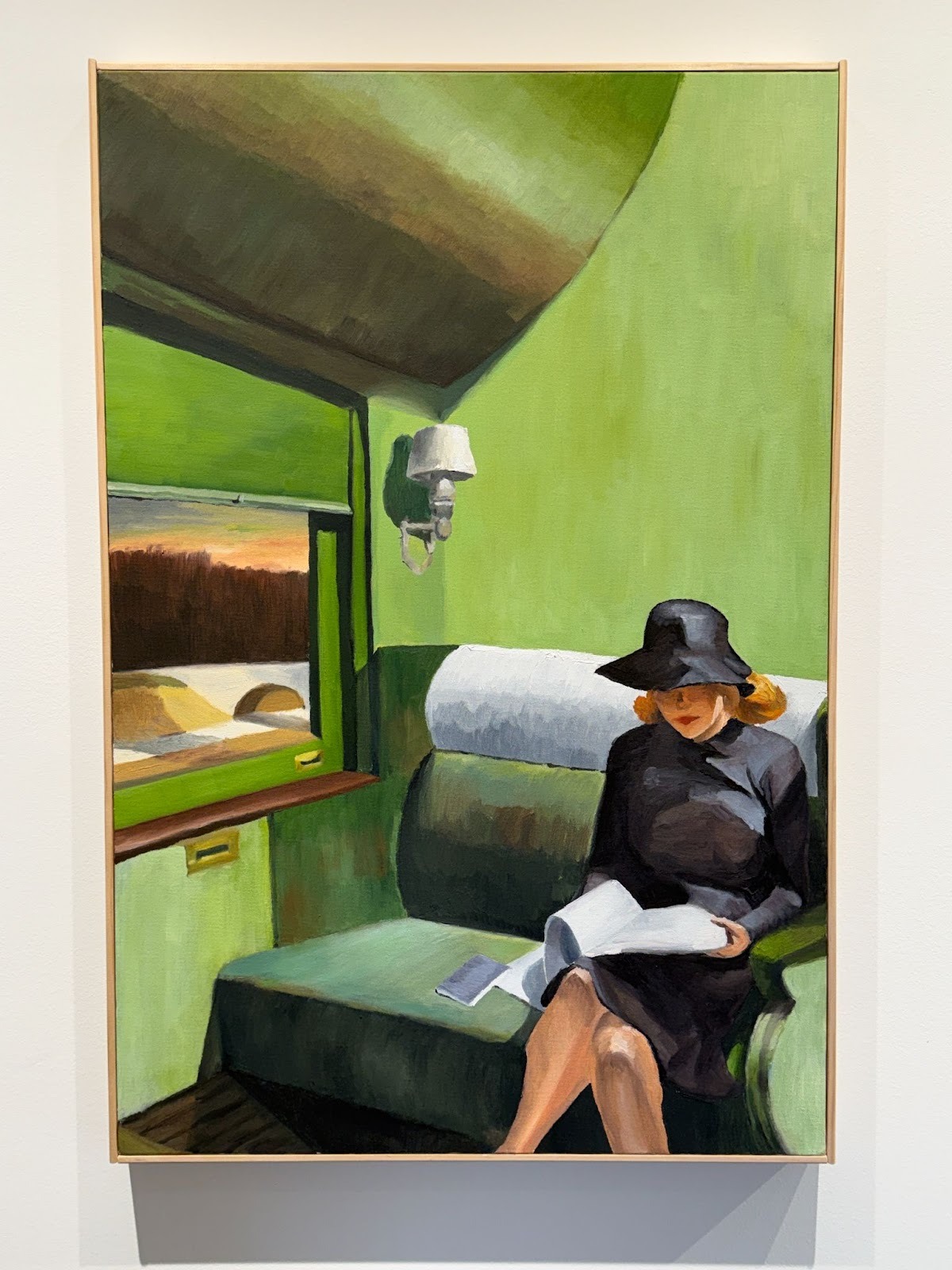
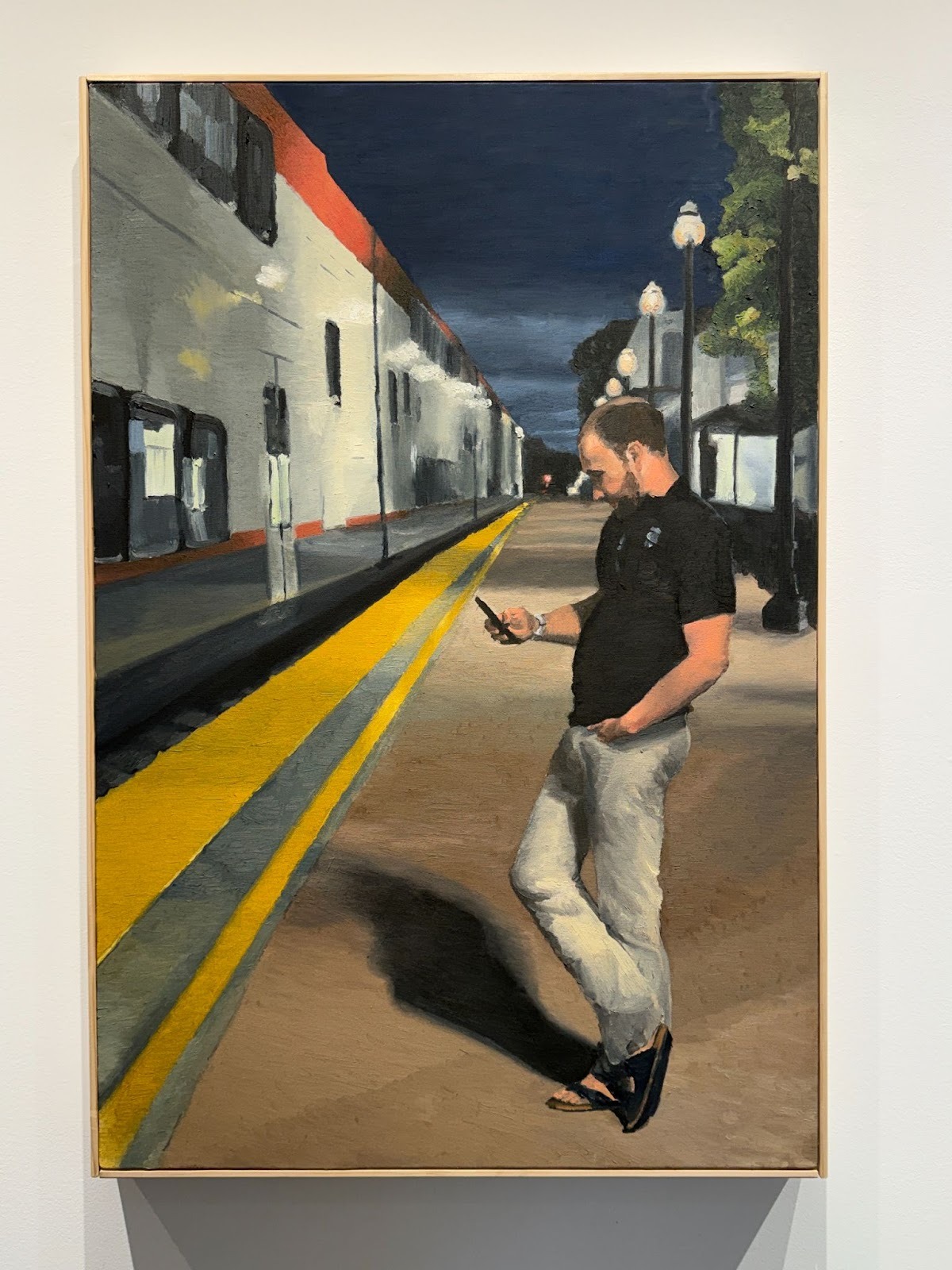
Katharine Wolf, “Compartment C, Car 293 (after Edward Hopper, 1938),” oil on canvas, 36 x 24 inches, 2025; Katharine Wolf, “Caltrain 155,” oil on canvas, 36 x 24 inches, 2025.
Katharine Wolf
Wolf wonderfully captures the mood of Edward Hopper’s original “Compartment C, Car 293,” particularly the quality of introspection, as the train passenger settles comfortably into enjoying silence and a book to get lost with. Large areas of the painting have color field areas where brushwork and depictions of light hitting off surfaces make for intriguing color variation. Wolf skillfully renders the original but also emphasizes green tones which helps to unify the painting emphasizing the theme of personal reflection and contemplative sentiment while encasing it in a subtle and ethereal quality. The figure has certain lines of emphasis which amplify the depth of the fabric and skin tone, again creating a sense of abstraction while retaining an adherence to realism.
In Wolf’s painting, “Caltrain 155,” we see her husband engaging with his phone while casually waiting at an otherwise deserted commuter rail station. Her choice of a Caltrain station in Redwood City is a modern equivalent of electric rail travel and elevates a relatively mundane action, waiting for the next train, into something precious, given its reference to Hopper’s painting. The scene at once becomes both relatable yet intimate to her personal life, showing a shared human thread tying us together through space and time.
All of the students’ original works created interesting dialogues with their source images. Color palette, emotional tone, and the posing of figures were the most common points of connection. The reasoning behind the assignment, according to Villalba, was that “Through this process of copying and creating, the artists engage in a dialogue across time, investigating how the act of studying the past can inform new artistic possibilities.” The exhibited works show how the exercise teaches students to apply paint and explore composition by quite literally retreading ground that has already proven successful. It’s an exercise that makes for a compelling exhibition as viewers get to ponder what they might have done under the same conditions.
Since beginning to teach full-time at the college in the fall of 2024, this is the third exhibition Villalba has mounted. The preceding shows included surveys of work by Bill Morales (a former professor at Cañada College) and by two legendary Bay Area Figurative painters, Paul Wonner and William Theophilus Brown. An exhibition of the contemporary realist painter Guy Diehl is planned to open in mid-January 2026 and will run through the spring semester.
–Matt Gonzalez

 Art & Politics: The Matt Gonzalez Reader
Leave a comment